Bag Production Line Technical Deep Dive: Synchronization and Line Balancing
A bag production line typically consists of multiple machines in series: extruder, printer (optional), bag maker, stacker, and packer. Each machine has its own maximum speed, and the line's overall throughput is determined by the slowest machine – the bottleneck. To achieve maximum efficiency, all machines must be synchronized and balanced so that their effective speeds are matched. This requires understanding each machine's cycle time, downtime, and setup time. The line is usually paced by the bag maker's speed, with upstream and downstream machines adjusted to match. For example, if the bag maker runs at 200 BPM, the printer must be able to print at that speed, and the extruder must supply film at that rate. The printer's speed is often the same as the bag maker since they are mechanically linked. The extruder, however, produces film continuously; its output in meters per minute must match the bag maker's film consumption. The bag maker's film consumption depends on bag length and width, so the extruder's line speed is set accordingly. A mismatch causes film accumulation or starvation, requiring a buffer.
Buffers are accumulators that store film between machines to compensate for short-term speed variations or stoppages. For example, an accumulator between the extruder and the printer can hold a few minutes of film, allowing the extruder to continue running while the bag maker stops for a roll change or cleanup. The accumulator uses festoon rollers that move to take up or release film. The amount of film stored is calculated based on the expected downtime of the downstream machine – typically 2-5 minutes worth. The accumulator's capacity is a design parameter; too small and it fails to prevent stoppages, too large and it takes up space and increases film tension variations. The accumulator's tension control must be independent of the main line tension, using a separate dancer and PID controller.
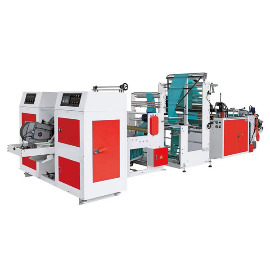
Plastic Bag Making Machine
Line balancing also involves scheduling changeovers. If the bag maker needs to change bag size, the printer may also need to change plates or ink, and the extruder may need to adjust thickness. To minimize downtime, these changeovers are coordinated – for example, the extruder and printer are set up while the bag maker completes its current order, and then the changeover is executed simultaneously. This requires a detailed changeover plan and trained personnel. The control system can assist by pre-loading recipes for each machine. The line's OEE is measured as the product of each machine's availability, performance, and quality. The bottleneck machine's OEE often determines the line's overall OEE.
Throughput optimization techniques include speed matching with a master speed reference – all machines follow the bag maker's speed. The bag maker's speed is set based on the order's required output, but it may be limited by film quality or sealing time. The extruder's output is controlled by adjusting its screw speed, but the screw speed must be within its optimal range to maintain melt quality. The printer's speed is adjusted by changing the impression cylinder speed. The line's control system uses a cascade control structure: the bag maker's speed is the primary setpoint; the extruder and printer follow with a small phase offset to maintain the accumulator level. If the accumulator level drops, the extruder speeds up; if it rises, the extruder slows down.
Line balancing is a continuous improvement process. Data from each machine – production counts, stoppages, rejects – is analyzed to identify the bottleneck. If the bottleneck is the bag maker, improvements may include upgrading to servo drives or reducing sealing time. If the printer is the bottleneck, adding more drying capacity or faster plate changes may help. By optimizing synchronization and balancing,
bag production lines can achieve throughput close to the theoretical maximum, reducing unit costs and improving delivery performance.