Bag Sealing Machine Technical Deep Dive: Impulse vs. Constant Heat Sealing Dynamics
The sealing mechanism in bag sealing machines fundamentally divides into impulse sealing and constant heat sealing, each with distinct thermal dynamics and application suitability. Impulse sealing uses a nichrome wire that is rapidly heated by a high-current pulse for a very short duration (typically 50-300 milliseconds), then allowed to cool quickly. This method is energy-efficient because heat is generated only during the seal cycle, and the rapid cooling prevents the film from sticking to the wire. The heating rate is controlled by the pulse duration and current amplitude; a typical impulse sealer delivers 50-100 A at low voltage (2-5V) for a 1-2 mm thick wire. The wire's resistance determines the heat generation (I²R), and its thermal mass dictates the cooling rate. The seal temperature profile is a sharp peak that must reach the film's melting point (typically 120-180°C for PE) and then drop below the sticking temperature (below 80°C) before the jaws open. The cooling time is critical; if the film is not cooled sufficiently, it will stick to the wire or the seal will be weak due to slow crystallization. The impulse method is ideal for intermittent operation and thin films (under 80 microns), where the rapid cycle prevents heat buildup in the film. However, the wire has a limited life (10,000-50,000 cycles) and must be replaced periodically, and the seal width is narrow (2-5 mm). In contrast, constant heat sealing maintains a heated bar at a set temperature continuously, using a PID controller and a solid-state relay to regulate power. The bar is typically made of aluminum or copper with embedded cartridge heaters. The temperature is maintained within ±2°C, and the film is pressed against the bar for a controlled dwell time. This method is suited for continuous high-speed production and thicker films (up to 300 microns), as it provides a wider seal (5-15 mm) and more consistent heat distribution. However, it consumes more energy (heater power is always on) and requires careful temperature management to avoid burn-through at slow speeds or film sticking.
The thermal response of impulse sealers is characterized by a fast rise time (10-20 ms) and a slower decay (100-200 ms) due to the wire's thermal inertia. The peak temperature is determined by the energy input; a common control method is to vary the pulse width at a fixed voltage, with a feedback loop measuring the wire resistance (which changes with temperature) to estimate the actual temperature. This is more reliable than time-based control because film thickness and ambient temperature affect cooling. Constant heat sealers have a slower response but maintain a steady state; they are more forgiving to film thickness variations because the heat is applied over a longer dwell. For high-speed machines (above 200 BPM), constant heat is preferred because impulse sealers cannot cool fast enough between cycles, causing the wire to overheat. However, impulse sealers are more energy-efficient for low-duty-cycle applications.
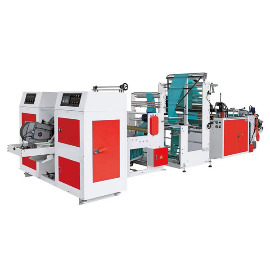
Plastic Bag Making Machine
Seal strength optimization depends on the temperature-time-pressure profile. The seal strength is a function of the degree of polymer interdiffusion, which is governed by the Arrhenius equation: higher temperature increases diffusion rate but also degradation rate. The optimal dwell time for constant heat is typically 0.2-0.8 seconds, while impulse sealers have a shorter effective dwell (the time the film is molten) of 10-50 ms. The pressure applied (2-6 bar) must be sufficient to ensure intimate contact but not so high as to squeeze out molten polymer, which thins the seal. For impulse sealers, the pressure must be applied before the pulse and maintained during cooling to prevent seal relaxation. The seal quality is evaluated by peel strength and burst strength; a good seal should fail by film tearing, not delamination. Statistical process control (SPC) charts monitor seal strength; if the variability exceeds 10%, temperature or pressure adjustments are needed.
Energy efficiency comparison: Impulse sealers consume energy only during the pulse, so they are more efficient for machines that run intermittently. However, the power supply for the pulse must deliver high current, requiring a large transformer and heavy wiring. Constant heat sealers draw continuous power, but their heat loss can be minimized by insulation and by using low-thermal-mass bars. A typical constant heat bar for a 500 mm width consumes 1-2 kW, while an impulse sealer consumes 5-10 kW per pulse but with a duty cycle of 5-10%, resulting in lower average power. For 24/7 operation, the energy cost difference is significant – a constant heat sealer may cost $2,000-$4,000 more per year in electricity. However, impulse sealers have higher maintenance costs due to wire replacement.
Advanced control strategies: Some modern sealers use a combination – a pre-heat stage to raise the film temperature, followed by a high-temperature impulse for bonding, and a cooling stage. This multi-stage profile improves seal strength for thick or multi-layer films. Also, temperature profiling across the bar (multiple zones) ensures uniformity; for impulse wires, the wire ends cool faster, causing weaker seals at the edges – compensation can be done by increasing the pulse duration or using a tapered wire (thicker at the ends). The control system can use an infrared sensor to measure the film surface temperature in real-time and adjust the heating profile. By understanding these thermal dynamics, engineers can select and optimize bag sealing machines for specific film materials and production speeds, achieving consistent high-strength seals with minimal energy and maintenance costs.