Bag Sealing Machine Technical Deep Dive: Ultrasonic Sealing and Advanced Bonding Techniques
Ultrasonic sealing is an advanced bonding technique that uses high-frequency mechanical vibrations (typically 20-40 kHz) to generate frictional heat internally within the film layers, rather than applying external heat. The sealing machine consists of a transducer (piezoelectric or magnetostrictive) that converts electrical energy into mechanical vibrations, a booster that amplifies the amplitude, and a horn (sonotrode) that applies the vibration to the film. The film is pressed between the horn and an anvil under moderate pressure (2-5 bar). The vibrations create intermolecular friction, raising the temperature at the interface to the melting point, and the pressure fuses the layers. The heating is instantaneous and localized, so no external heat is required, and the sealing time is very short (0.1-0.5 seconds). Ultrasonic sealing is ideal for heat-sensitive films (biodegradable PLA, EVOH) and laminated films where external heat would damage the barrier layer. It also produces a clean, strong seal without burn-through, and the seal strength is often higher than heat sealing because the molecular interdiffusion is more uniform. The process is energy-efficient because energy is only applied during the weld, and no warm-up time is needed.
The key parameters for ultrasonic sealing are frequency, amplitude, welding time, and pressure. Frequency determines the vibration cycle; 20 kHz is common for thicker films (100+ microns) because it provides higher energy, while 35-40 kHz is used for thin films (<50 microns) to reduce the risk of film puncture. Amplitude (typically 10-50 microns) controls the amount of frictional heat – higher amplitude increases temperature but can cause film damage. The welding time is the duration of vibration application; for most films, 0.2-0.5 seconds is sufficient. The pressure must be sufficient to maintain contact but low enough to allow the film to flow. The anvil design is critical – it must provide a uniform support surface; a textured anvil can improve grip. The horn must be tuned to the resonant frequency; any deviation causes efficiency loss. The horn material is usually titanium or aluminum, with a wear-resistant coating.
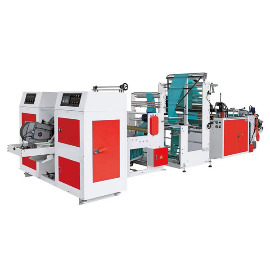
Plastic Bag Making Machine
Seal quality is influenced by film crystallinity and additives. Highly crystalline polymers (like HDPE) require higher energy because they have higher melting points; amorphous polymers (like PLA) seal more easily. Slip agents and anti-block additives can reduce frictional heat generation, requiring higher amplitude or longer welding time. The seal integrity is tested by peel and burst tests; ultrasonic seals often exhibit a peel strength that is 20-30% higher than heat seals for the same film, because the localized heating preserves the film's mechanical properties. The seal width is determined by the horn's contact area; typical widths are 2-10 mm. Ultrasonic sealing is also capable of sealing through contamination (e.g., dusty films) because the vibration can displace surface particles.
Process control: The ultrasonic generator has a feedback loop that monitors the power consumption and frequency during the weld. A drop in power indicates a poor coupling (misalignment) or film slipping; an increase indicates excessive energy (possibly damaging). The system can adjust the amplitude or time in real-time to maintain consistent seal quality. The generator can also record data for each seal, allowing SPC monitoring. Ultrasonic sealers are often integrated with bag makers for continuous operation; the horn is mounted on a servo-driven axis that moves with the film during the seal (for continuous motion) or operates in a stationary mode (for intermittent machines). For high-speed lines, multiple ultrasonic heads can be used in parallel to increase throughput.
Maintenance: The horn and anvil are subject to wear and must be inspected regularly; any erosion or cracking reduces efficiency. The piezoelectric transducers have a long life (>10,000 hours) but can fail due to thermal stress. The generator's power supply needs periodic calibration. Ultrasonic sealing systems are more expensive upfront than heat sealers but offer lower operating costs (no heater replacement, lower energy) and better seal quality for advanced films. As the packaging industry moves toward sustainable, heat-sensitive materials, ultrasonic sealing is becoming increasingly important. By mastering ultrasonic bonding parameters, engineers can achieve high-integrity seals on a wide range of films, enabling innovative packaging designs and reducing waste due to seal defects.