Bagging Machine Technical Deep Dive: Form-Fill-Seal Integration and Bagging Dynamics
Bagging machines, particularly vertical form-fill-seal (VFFS) systems, combine bag forming, filling, and sealing in a single integrated process. The machine forms a bag from a flat film, fills it with the product, and seals it – all in a continuous cycle. The integration requires precise synchronization of the film forming, product weighing, and sealing operations. The film is drawn from a roll, formed into a tube around a filling collar, and longitudinally sealed (back seal). The tube is then pulled downward by a pair of pull belts. At the bottom, cross-seal jaws close to seal the bottom of the current bag and the top of the previous bag simultaneously. The product is then dropped through the filling tube into the open bag, and the cycle repeats. The critical timing is the interval between the bottom seal and the top seal – during this time, the product must be weighed and discharged. For a machine running at 100 bags/min, the cycle time is 600 ms, leaving only 300 ms for weighing and product discharge after the bottom seal. Therefore, the weighing system must be extremely fast – typically using a multi-head weigher with a response time under 100 ms. The product flow is controlled by a vibratory feeder or auger filler, with feedback from the weigh scale to adjust feed rate. The scale's accuracy is typically ±0.5-1.0 grams for small bags, and ±5 grams for larger ones.
The film forming section of a VFFS bagging machine uses a forming collar (shoulder) that wraps the flat film around the filling tube. The collar geometry is tailored to the film width and bag width – a common design uses a circular tube for free-flowing products, and a rectangular tube for fragile items. The film tension must be precisely controlled to avoid wrinkling and ensure a straight back seal. The back seal is made by a heated bar or a hot air nozzle that melts the film's overlapping edges. The sealing temperature is typically 150-200°C for PE films. The cross-seal jaws are servo-driven, with independent temperature zones for the top and bottom seals. The jaws close with a force of 2-5 kN, and the dwell time is 0.2-0.5 seconds. The jaws may be equipped with serrated or flat surfaces, depending on the desired seal pattern. A cooling block is often integrated into the jaws to set the seal before the film is released, preventing sticking.
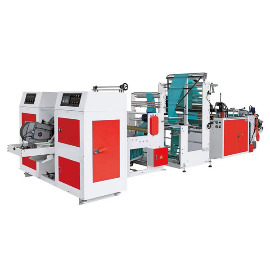
Plastic Bag Making Machine
Product handling is a major challenge for sticky or abrasive products. The filling tube must be smooth and often coated with a low-friction material. The discharge gate must open and close rapidly without jamming – pneumatic or servo-driven butterfly valves are common. The dust from powders is extracted by a vacuum system to prevent contamination of the seal area. For liquid products, the machine uses a liquid filler with a nozzle that reaches into the bag to reduce splashing. The bag's bottom seal must be leak-proof; a leak tester can be integrated to reject defective bags. The sealing parameters are adjusted based on product properties – for oily products, a higher temperature may be needed to overcome contamination.
The control system for VFFS
bagging machines must handle multiple axes: film feed, pull belts, cross-seal jaws, product discharge, and sometimes a gas flush system for MAP (modified atmosphere packaging). The motion controller uses electronic camming to synchronize all axes. The product weighing system communicates with the main PLC via a high-speed bus, and the PLC calculates the optimal fill timing to minimize cycle time. Advanced machines use a predictive algorithm that adjusts the fill start time based on the weight variation history, reducing the settling time. The entire system is monitored by a suite of sensors – temperature, pressure, position, and weight – with alarms for deviations.
Maintenance of VFFS bagging machines involves cleaning the filling tube and discharge gate daily to prevent product buildup. The cross-seal jaws require regular cleaning and temperature calibration. The pull belts wear and must be replaced periodically to maintain consistent tube tension. The weighing system needs daily calibration with standard weights. By integrating these functions effectively, bagging machines achieve high-speed, accurate filling and sealing, making them indispensable in the food, chemical, and pharmaceutical industries.