Bagging Machine Technical Deep Dive: Pre-Made Bag Filling and Sealing Systems
Pre-made bag filling bagging machines handle bags that have been pre-formed and stacked in a magazine. The process involves picking a bag from the stack, opening it, placing it on a filling spout, filling the product, and then sealing the bag. This approach is more flexible than VFFS because it can handle a wider variety of bag styles (including zipper, stand-up, and gusseted bags) and products (including bulky, irregular, or fragile items). The machine typically uses a rotary turret design with multiple stations, each performing a step in sequence. A typical 8-station turret might have: station 1 – bag pick-up, station 2 – bag opening, station 3 – bag placement on spout, station 4 – filling, station 5 – filling verification, station 6 – top sealing, station 7 – cooling, station 8 – discharge. The turret rotates intermittently, with each station completing its operation during the dwell period. The cycle time is determined by the slowest station; for a 60 bags/min machine, each station has 1 second to complete its task. The bag pick-up uses vacuum cups mounted on a robotic arm or a cam-driven mechanism to take a bag from the magazine. The bag opening is achieved by blowing air into the bag while vacuum cups hold the front and back panels apart. The opened bag is then transferred onto a filling spout – the spout may be a simple tube or a multi-jet head for liquids.
The filling station is critical for product accuracy and speed. For granular products, a net-weigh scale discharges the product through a chute into the bag. For liquids, a positive displacement pump or a flow meter controls the volume. The spout may be equipped with an air evacuation nozzle to remove air from the bag before sealing, reducing package volume. After filling, the bag is transported to the sealing station. The sealing method can be heat sealing (for plastic films), ultrasonic sealing (for sensitive films), or clip sealing (for woven bags). Heat sealing uses heated jaws with temperature control; ultrasonic uses high-frequency vibrations to generate frictional heat. The seal must be strong enough to withstand handling and transport. The seal integrity is tested by an in-line leak detector or a vision system that inspects seal width and appearance. Rejected bags are automatically ejected.
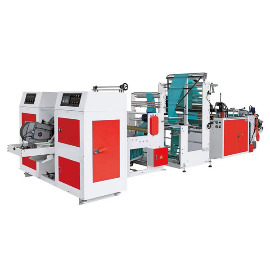
Plastic Bag Making Machine
The rotary turret's indexing mechanism must provide precise positioning with minimal backlash. Servo-driven cam indexers or direct drive torque motors are used. The acceleration and deceleration of the turret must be smooth to prevent bag misalignment or product spillage. The filling spouts are often interchangeable to handle different bag sizes, with quick-release couplings for changeover. The magazine for empty bags must be continuously loaded – an automatic bag magazine feeder is common for high-volume lines. The bag opening sensors verify that the bag is fully open before filling; if not, the station is skipped and the bag is rejected.
Control system: The PLC coordinates the turret indexing, bag handling, filling, and sealing. The motion controller uses a master encoder on the turret to synchronize all servo axes. The filling scale communicates via serial bus, and the sealing temperature controllers are integrated. The HMI provides recipe management for different bag sizes and products – changeover is typically under 15 minutes. Safety light curtains prevent operator access during rotation.
Maintenance: The vacuum cups wear and must be replaced; the opening air nozzles can clog with dust; the sealing jaws need cleaning and temperature calibration. The filling spout's seals and O-rings require periodic inspection for leaks. The turret bearings must be greased regularly. By using pre-made bag filling
bagging machines, manufacturers can achieve high flexibility and quality, handling a diverse product range with minimal changeover time, making them ideal for contract packaging and custom orders.