Bottom Sealing Bag Making Machine Technical Deep Dive: Film Cutting and Edge Trim Recycling
In bottom sealing bag making machines, film cutting is performed after sealing to separate individual bags. The cutting mechanism is typically a rotary knife (for high speed) or a guillotine (for heavier films). Rotary cutters use a cylindrical blade that shears the film against an anvil roller, with a gap of 0.01-0.03 mm. The blade speed is synchronized with the film pull to avoid dragging. The cut quality depends on blade sharpness, gap, and anvil condition. Dull blades produce ragged edges and film dust, which can contaminate the sealing area. The blade life is 5-10 million cuts; regular sharpening or replacement is scheduled based on a counter. Some machines use a ceramic blade for extended life. The anvil roller, often made of hardened steel or polyurethane, wears over time; its surface is periodically ground to restore concentricity. The cutting station also includes a dust extraction system to remove film particles, preventing them from affecting the sealing or stacking.
Edge trim recycling: During bag making, the film edges are often trimmed to achieve the precise bag width. The edge trim width is typically 5-20 mm per side, representing 2-5% of the film input. To reduce waste, many bottom sealing bag making machines are integrated with an edge trim granulator. The trim is pulled by a pair of nip rollers into a granulator, where rotating blades chop it into flakes (5-10 mm size). The flakes are then pneumatically conveyed back to the extruder (if in-line extrusion is used) or collected for off-line recycling. In-line recycling requires careful control of the recycled flake percentage (typically 10-30%) to maintain film properties. The granulator's blade clearance (0.1-0.2 mm) and screen size determine the flake quality; fines (dust) should be minimized because they degrade film quality. The granulator's motor current is monitored; a sudden increase indicates blade dulling or a jam. The trim pulling speed must be synchronized with the film speed; a servo-driven nip roller ensures consistent pull. The trim is also guided by edge guides to prevent wandering.
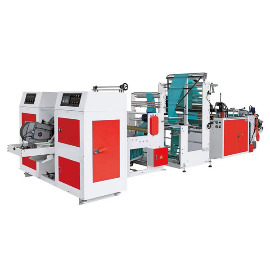
Plastic Bag Making Machine
Optimization of trim width: The trim width should be minimized to reduce waste, but it must be sufficient to ensure consistent edge quality and to accommodate film wandering. The edge guide system's accuracy determines the minimum trim width; with a high-precision edge guide (±0.5 mm), the trim can be reduced to 2-3 mm per side. Some machines use a "zero trim" process where the film is slit to the exact bag width, eliminating edge trim. This requires a slitting station before the bag maker and precise film width control from the extruder. Zero trim reduces waste and energy consumption but requires higher film width consistency.
Quality control of cutting: The cut edge is inspected visually or by a camera; any roughness triggers an alert. The bag length is measured and compared to the setpoint; the cut timing is adjusted by the registration system. The machine's control system logs the trim weight and granulator output, providing data for waste reduction initiatives. By implementing efficient cutting and edge trim recycling,
bottom sealing bag making machines achieve higher material utilization, lower production costs, and improved sustainability, meeting the growing demand for eco-friendly packaging.