Bottom Sealing Bag Making Machine Technical Deep Dive: Seal Bar Temperature Uniformity and Control
The bottom sealing bar is the heart of a bottom sealing bag making machine, responsible for creating a strong, uniform seal across the full width of the bag. The critical technical challenge is achieving and maintaining temperature uniformity along the entire bar length, typically 300-1200 mm, within ±1-2°C. Temperature gradients arise from heat loss at the bar ends, uneven heater wattage, and airflow around the bar. To address this, the bar is divided into multiple heating zones (typically 3-5), each with its own cartridge heater and thermocouple, independently controlled by a PID loop. The heater density is higher near the ends to compensate for greater heat loss. The bar material is copper or aluminum, with copper providing superior thermal conductivity (401 W/m·K) for faster equalization. Finite element analysis (FEA) is used to simulate the steady-state temperature distribution, optimizing heater placement and zone lengths. The PID controller's parameters (proportional, integral, derivative gains) are tuned based on the bar's thermal time constant (typically 10-30 seconds). Auto-tuning routines in modern controllers automatically determine optimal gains, but manual fine-tuning is often needed for specific film types. The controller also includes an anti-windup function to prevent integral overshoot during temperature changes. A feed-forward signal from the machine speed anticipates the heat extraction during sealing, increasing power before the temperature drops.
The temperature sensor (thermocouple or RTD) must be placed as close as possible to the sealing surface – typically within 2-5 mm – to minimize measurement lag. The thermocouple type (J or K) and its response time (under 0.5 seconds) are specified. The heater elements are solid-state relay (SSR)-controlled with zero-crossing switching to reduce electrical noise. The SSR's duty cycle is adjusted based on the PID output. The control system also monitors the heater current; a deviation from the expected value indicates a failing heater or a poor connection. Some advanced systems use a thermal camera to measure the bar's surface temperature in real-time, providing feedback for closed-loop zone adjustment, achieving uniformity within ±0.5°C. The temperature profile can be programmed to have a slight increase at the ends (e.g., +2°C) to compensate for edge heat loss. The thermal system's performance is validated by a thermal mapping procedure using a multi-channel data logger and a calibrated thermocouple grid.
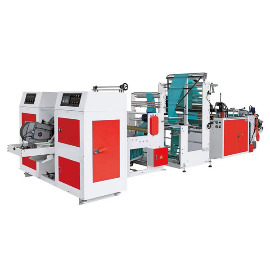
Plastic Bag Making Machine
The sealing bar's surface coating (PTFE or silicone) adds thermal resistance, affecting the effective temperature at the film interface. The coating thickness must be consistent – variations of 0.05 mm cause temperature deviations. The coating is replaced periodically, and the controller may need recalibration after replacement. The thermal expansion of the bar (about 0.01 mm/m per °C) causes length changes that can affect alignment; the machine's frame accommodates this with floating mounts. The cooling system, typically a water-cooled chill roller after the seal, must remove heat rapidly to solidify the seal. The chill roller's temperature is controlled by a separate PID loop, set 10-20°C below the film's softening point. The interaction between the sealing bar temperature and the chill roller temperature affects the seal's crystallinity; slower cooling leads to higher crystallinity and tougher seals, but requires longer cooling times. The control system can adjust the chill roller temperature based on the film type and speed. By achieving precise temperature uniformity and control, bottom sealing bag making machines produce consistent, strong seals across all bags, minimizing rejects and ensuring product integrity for a wide range of packaging applications.