CE Certified Bag Making Machine Technical Deep Dive: Safety Circuit Design and Functional Safety
CE certification for bag making machines requires compliance with the Machinery Directive 2006/42/EC, which mandates that the machine be designed to eliminate or reduce risks to operators. The safety system is not just an add-on – it must be integrated into the machine's control architecture, with safety-related functions performed by dedicated safety components such as safety PLCs, safety relays, light curtains, interlocking guards, and emergency stop switches. The safety circuit must be designed to be fail-safe: in the event of a component failure, the machine should shut down in a safe state. The European standard EN ISO 13849-1 defines Performance Levels (PL) for safety functions, from PL a (lowest) to PL e (highest). For bag making machines, the required PL is typically PL d or e, depending on the severity of potential injury. A typical bag making machine has safety functions: emergency stop (PL e), guard locking (PL d), and two-hand control (PL c). The design starts with a risk assessment (according to EN ISO 12100) that identifies all hazards – moving parts, hot surfaces, electrical shock, noise. For each hazard, the risk is evaluated by severity (S), frequency of exposure (F), and possibility of avoidance (P). The required PL is derived from the risk graph. For example, if the hazard is severe (S2), frequent (F2), and difficult to avoid (P2), the required PL is e.
Safety circuit architecture: For PL e, redundant hardware is required. A typical emergency stop circuit uses two redundant channels: each emergency stop pushbutton has two normally closed contacts that are wired to a safety relay with dual inputs. The safety relay monitors the contacts for short circuits and cross-faults. It requires manual reset after activation. The safety relay outputs control two redundant contactors that disconnect power to the main drives and servos. The contactors are monitored for welding – their auxiliary contacts feed back to the safety relay. If a contactor fails to open, the safety relay remains in the tripped state. For light curtains, the safety relay monitors the OSSD (output signal switching device) outputs, which are dual signals with pulse testing. If the light curtain is interrupted, the safety relay trips. The safety relay must have a diagnostic coverage (DC) >99% for PL e. Modern systems use safety PLCs that can implement multiple safety functions in software, with self-testing and cross-monitoring. The safety PLC has two processors running the same program in lockstep, comparing outputs; if they differ, the system shuts down.
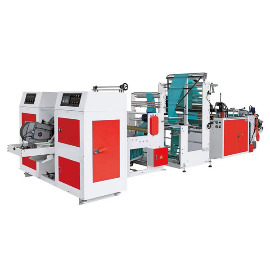
Plastic Bag Making Machine
Functional safety validation: After installation, the safety functions must be validated by testing. This includes: activating each emergency stop and verifying that all hazardous motion stops within the specified time (e.g., under 50 ms). Testing the light curtain by breaking the beam and checking that the machine stops and cannot restart until reset. Testing guard interlocks – opening a guard door must stop the machine. The test results are documented in a validation report. The machine's safety manual provides instructions for periodic functional tests (e.g., daily check of emergency stops, weekly check of light curtains). The safety system must also be protected against tampering – reset buttons must be placed outside the danger zone, and keys for mode switches are controlled.
Safety-related software: If the safety functions are implemented in a safety PLC, the software must be developed according to EN 61508, using certified development tools and following a structured lifecycle. The software must include diagnostic measures such as memory checks, sequence monitoring, and plausibility checks. The safety PLC's communication with the non-safety PLC is via a safety protocol (PROFIsafe) that includes CRC and sequence numbers to detect data corruption. The safety program is typically simpler and separated from the main logic to reduce complexity and error.
Retrofit considerations: If an existing machine is upgraded to CE certification, the safety system must be redesigned. This often involves replacing the old control panel with a safety relay, adding light curtains, and updating the emergency stop network. The cost can be significant but is essential for legal compliance and liability reduction. The CE mark is affixed after the machine passes the conformity assessment, including testing of safety functions. By designing robust safety circuits and validating them thoroughly,
CE certified bag making machines ensure operator safety and legal compliance, enabling market access in the EU and other regions.