CE certified bag making machine
A CE certified bag making machine is equipment that has been assessed and verified to comply with the essential health, safety, and environmental protection requirements of the European Union's CE marking directives. For a bag making machine, this typically includes the Machinery Directive 2006/42/EC, Low Voltage Directive 2014/35/EU, and Electromagnetic Compatibility Directive 2014/30/EU. CE certification is mandatory for machines sold within the European Economic Area, but it is also increasingly sought by international buyers who view the CE mark as a hallmark of quality and safety. Achieving CE certification involves rigorous testing of mechanical guards, electrical safety, noise emission, and documentation of the machine's risk assessment, ensuring that it meets stringent European standards. For manufacturers, offering CE certified bag making machines opens access to the lucrative European market and demonstrates a commitment to product safety and reliability.
The certification process for a CE certified bag making machine involves several stages: risk assessment, conformity assessment, technical documentation, and declaration of conformity. First, the manufacturer conducts a detailed risk analysis according to EN ISO 12100, identifying all potential hazards such as moving parts, electrical shocks, hot surfaces, and noise. Based on the risk assessment, appropriate safety measures are designed, including guards, two-hand controls, emergency stops, and light curtains. Next, the machine undergoes type testing by a notified body (if required) or self-assessment for lower risk categories, covering electrical safety (EN 60204-1), noise measurement (EN ISO 11202), and electromagnetic emissions. The manufacturer then compiles a technical file containing drawings, schematics, component certificates, test reports, and the user manual. Finally, the manufacturer issues a Declaration of Conformity and affixes the CE mark to the machine. For complex or high-risk machinery, involvement of a notified body is mandatory, adding cost but providing third-party validation.
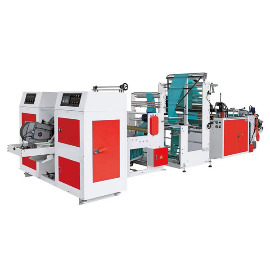
Plastic Bag Making Machine
Key safety features mandated for CE certified bag making machines include interlocking guards, e-stop circuits, and protection against thermal hazards. Interlocking guards with safety relays ensure that operators cannot access moving parts while the machine is running; these guards must have a positive-opening mechanism and be monitored by dual-channel safety inputs. Emergency stop buttons, colored red on yellow background, are placed at multiple locations around the machine and must bring all hazardous motion to a stop within a defined time (typically under 0.5 seconds). Electrical cabinets must have IP54 or higher enclosure, with proper grounding and overcurrent protection. Hot surfaces (sealing bars) exceeding 80°C are shielded with thermal insulation or warning labels. Noise emissions are measured and declared, with values typically below 80 dB(A) for CE compliant machines. The machine's software must also include safety-related functions such as monitoring of motor torque and speed to detect faults, with a failsafe stop in case of deviation. All safety components must be from certified suppliers and have documented performance levels.
Benefits of purchasing a
CE certified bag making machine extend beyond regulatory compliance. First, it assures buyers that the machine has undergone thorough safety evaluation, reducing the risk of workplace accidents and associated liabilities. Second, CE certified machines often have better build quality, as the certification process encourages manufacturers to use higher-grade materials and robust design principles. Third, many insurance companies offer lower premiums for factories using CE certified equipment, recognizing the reduced risk. Fourth, CE certification facilitates international trade – even in non-EU countries, CE marking is often accepted as evidence of compliance with international standards, simplifying customs clearance. Fifth, the comprehensive technical documentation required for CE certification, including detailed circuit diagrams and parts lists, makes maintenance and troubleshooting easier for the end-user. Finally, many large retailers and brand owners mandate that their packaging suppliers use CE certified equipment to ensure safety and quality throughout the supply chain.
Applications of CE certified bag making machines are prevalent in countries that adopt European standards, but also among multinational companies that apply global safety policies. European converters are legally required to use CE certified machines, and many export-oriented manufacturers in Asia and the Americas also invest in CE certification to serve European clients. In the food and pharmaceutical sectors, CE certification is often a prerequisite for machine approval by quality assurance departments, as it provides documented evidence of safety. For machines installed in factories that have OHSAS 18001 or ISO 45001 certification, using CE marked equipment simplifies compliance with occupational health and safety management systems. Furthermore, CE certified machines are frequently preferred in government tenders and large corporate procurement, as they demonstrate a higher level of product maturity and manufacturer accountability.
When buying a CE certified bag making machine, verify that the certification is genuine and covers the specific machine model. Request a copy of the Declaration of Conformity and check that it lists the relevant directives and harmonized standards. Examine the technical file for completeness and ensure that the risk assessment addresses your specific working conditions, such as ambient temperature or dust levels. Ask for test reports from accredited laboratories for electrical safety and EMC, if available. Ensure the machine's nameplate displays the CE mark clearly and includes the manufacturer's name and year of manufacture. Check that the user manual includes safety instructions in your local language, as required by the directive. Also, inquire whether the certification covers any optional modules you are purchasing, such as automatic splicing or printing units, as these may require separate assessments. Finally, consider the supplier's ongoing compliance – CE requirements evolve, and a responsible supplier will update their machines accordingly and provide retrofits if needed.
Maintaining the CE certification status requires that the machine remains in compliance after installation and during its lifetime. Owners must keep the technical documentation and safety-related components as originally certified; any modifications that affect safety – such as changing guards, control systems, or electrical components – may invalidate the CE marking unless re-assessed. Routine maintenance should use only certified replacement parts (e.g., safety relays with same performance level). Periodic inspection of safety functions is mandatory: test all emergency stops, interlock switches, and light curtains weekly, and document the results. Conduct an annual full risk assessment review, especially if the machine is used for new bag types or materials that could alter the hazard profile. In case of an accident or near-miss, the CE documentation is crucial for investigation and liability. By keeping the machine in its certified state and following the manufacturer's instructions, owners can maintain a safe working environment, comply with regulations, and preserve the machine's resale value.