Computer Controlled Bag Making Machine Technical Deep Dive: Predictive Maintenance and Machine Learning
Computer controlled bag making machines generate vast amounts of operational data – temperature, pressure, current, vibration, position error – that can be harnessed for predictive maintenance. Unlike traditional scheduled maintenance, predictive maintenance uses machine learning models to detect early signs of degradation and predict the remaining useful life (RUL) of components. The first step is data collection: the machine logs sensor data at high frequency (1-10 kHz) over months of operation. This data is labeled with maintenance events (e.g., heater replacement, blade change, bearing failure) and quality outcomes. Features are extracted from the raw data: for vibration, features include RMS, peak-to-peak, spectral band power, and kurtosis. For temperature, features include rise time, overshoot, and settling time. The feature set is reduced using principal component analysis (PCA) to avoid overfitting. A machine learning model, such as a random forest classifier, support vector machine, or neural network, is trained on historical data to classify the machine's health state (healthy, warning, critical). Anomaly detection models, such as autoencoders or isolation forests, can flag unusual patterns that may precede failure, even if not seen before.
RUL estimation is more challenging. It involves regression models that predict the remaining time until failure. This can be done using survival analysis or recurrent neural networks (LSTM) that process time-series data. The model is trained on run-to-failure data (when components were run until they failed) to learn the degradation trajectory. For example, for a sealing bar heater, the model may learn that an increase in power required to maintain temperature, combined with an increase in temperature fluctuation, indicates that the heater is degrading; based on historical data, it estimates that 200 more operating hours remain. The model provides a confidence interval. The machine's control system uses this estimate to schedule maintenance during planned downtime, avoiding unplanned stoppages. The model is retrained periodically as new data accumulates.
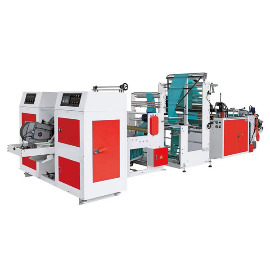
Plastic Bag Making Machine
Integration with maintenance management: The predictive system outputs a maintenance recommendation to the HMI and to the plant's CMMS (computerized maintenance management system). The recommendation includes the component, the estimated RUL, the recommended action (e.g., "replace heater in next 100 hours"), and the required parts. The system also tracks inventory of spare parts and alerts if the part is not in stock. The maintenance planner can acknowledge the recommendation and schedule the task. After maintenance, the operator enters the action taken, and the machine's data is updated to reflect the new component installation (resetting its life counter).
Data quality and labeling: For the model to be accurate, the data must be clean (remove outliers, fill missing values) and correctly labeled. Labeling requires accurate records of maintenance events and failure modes. The system can use a semi-supervised approach where the model flags potential faults, and the operator confirms or rejects, providing feedback to improve the model. Over time, the model's accuracy improves. The computational cost of training deep learning models is high, so training is often done offline on a server or cloud, and the trained model is deployed on the IPC for inference. The inference is fast (milliseconds) and runs in real-time.
Predictive maintenance benefits: Studies show that predictive maintenance can reduce unplanned downtime by 30-50%, extend component life by 20-30%, and lower maintenance costs by 10-20%. For a bag making machine, avoiding a 4-hour breakdown saves the cost of lost production (e.g., $2,000) and expedited repairs. The system also improves safety by preventing catastrophic failures. By implementing machine learning-based predictive maintenance,
computer controlled bag making machines achieve high reliability, reduce total cost of ownership, and increase overall equipment effectiveness, making them a strategic asset for high-volume production.