Computer Controlled Bag Making Machine Technical Deep Dive: Software Architecture and Database Integration
Computer controlled bag making machines are distinguished by their powerful industrial PCs (IPC) running a full operating system (Windows or Linux) and specialized bag making software. Unlike PLC-only machines, these computers can run complex algorithms, store large databases, and integrate with external systems. The software architecture is typically modular: a motion control module communicates with servo drives over EtherCAT; a temperature control module handles PID loops; a data acquisition module logs sensor data; a recipe management module stores and retrieves machine settings; an HMI module provides a graphical interface; and a communication module handles OPC UA, MQTT, or REST APIs for integration with MES/ERP. The modules run as separate threads or processes, with inter-process communication (IPC) using shared memory or message queues. The software must be real-time capable – the motion control loop must run at 1 kHz or higher, so the IPC often uses a real-time extension (e.g., Linux with PREEMPT_RT) or a separate motion controller with its own firmware. The HMI runs in a separate process with lower priority to avoid interfering with real-time tasks.
Recipe management is a key advantage. The software can store thousands of recipes, each containing parameters: bag length, width, sealing temperature, pressure, dwell time, cut length, registration offset, punch settings, and stacker bundle count. The recipes can be organized by product type and customer. The operator can recall a recipe with a few touches, and the machine automatically adjusts all axes. The recipe database is stored in a SQLite or MySQL database on the IPC's solid-state drive, with automatic backup to a network drive. The database can also store production logs – each shift's production count, reject count, downtime reasons, and alarm history. This data can be exported as CSV or JSON for analysis. The database also stores the maintenance schedule and component life counters (e.g., heater operating hours, blade cycles). The software can alert when a component is due for replacement.
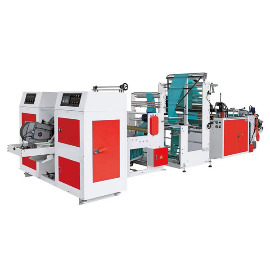
Plastic Bag Making Machine
Data acquisition and analytics: The computer collects data from all sensors at high frequency – typically 100 Hz for temperature and pressure, 1 kHz for position and current. This data is stored in a time-series database (e.g., InfluxDB) on the IPC or sent to a cloud platform. The software can perform real-time analytics: compute moving averages, detect outliers, and calculate OEE. It can also use machine learning models (e.g., anomaly detection) to predict failures. The data is visualized on the HMI with trend charts and histograms. The operator can overlay historical data to compare current production with a reference run. For example, if the sealing temperature trend shows increasing drift, the software may recommend thermocouple replacement.
Connectivity: The computer supports OPC UA, which is a platform-independent standard for secure data exchange. The machine can act as an OPC UA server, exposing all variables (temperature, speed, counts, alarms) to a client (MES, SCADA). The communication is encrypted with certificates. The machine also supports MQTT for cloud integration – it can publish production data to a cloud broker for remote monitoring. The computer has a built-in web server that allows access via a browser for diagnostics, even from a mobile device. Remote access is secured with VPN and two-factor authentication.
Software maintenance: The IPC runs antivirus software and receives regular security patches. The bag making software is updated via a dedicated update tool that verifies the integrity of the update. The update can be performed remotely by the supplier, with the operator's consent. The software logs all configuration changes, providing traceability for quality audits. By leveraging a computer controlled architecture, bag making machines achieve advanced functionality, data-driven optimization, and seamless integration into Industry 4.0 ecosystems, enabling predictive maintenance, quality prediction, and production transparency.