Flat Bag Making Machine Technical Deep Dive: High-Speed Intermittent Motion and Acceleration Control
Flat bag making machines are often the fastest among all bag types, with some models achieving 300 BPM or more. This high speed is achieved by using intermittent motion: the film is rapidly pulled forward, stopped, sealed, cut, and then pulled again. The cycle time at 300 BPM is 200 ms. The film must be accelerated from zero to peak speed (e.g., 10 m/s) and decelerated to zero within about 100 ms. This requires extremely high acceleration (e.g., 100 m/s²) and precise control to avoid film stretch and registration errors. The film pull servo must have high torque and low inertia to achieve such acceleration. The pull roller is often made of lightweight aluminum with a polyurethane coating for grip. The servo drive uses advanced algorithms: the acceleration profile is S-curved, with jerk limits to reduce tension spikes. The tension control is critical – the film's inertia causes a tension surge during acceleration, which can stretch the film and cause wrinkling. To compensate, the unwind brake is actively controlled to reduce tension during acceleration and increase during deceleration, using a feed-forward signal from the pull servo.
The stop period is equally challenging. The film must settle within 1-2 ms to allow the sealing and cutting to occur at the correct position. Any overshoot or oscillation causes mis-registration. The servo's position loop is tuned with high proportional gain to achieve fast settling, but this can cause overshoot. Therefore, the motion profile includes a "dwell" at the end of the deceleration, where the servo applies a holding torque to keep the film exactly at the target position. The holding torque is set to overcome the film's tension. The registration sensor measures the actual position during the dwell and adjusts the next pull distance to correct any error. This closed-loop compensation ensures that the bag length remains within tolerance despite variations in film slip.
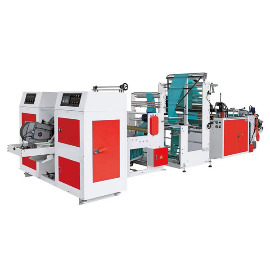
Plastic Bag Making Machine
Mechanical design for intermittent motion: The machine's moving parts must be lightweight to reduce inertia. The pull roller is directly coupled to the servo motor (or via a timing belt) to eliminate backlash. The film path is minimized to reduce the amount of film that can stretch. The sealing and cutting mechanisms are designed to operate during the stop period, so they must be fast-acting. For sealing, impulse heating is often used because it can heat and cool rapidly, matching the stop duration. For cutting, a rotary cutter is preferred because it does not require stopping the film; however, for intermittent machines, a guillotine cutter is used but must be synchronized with the stop.
Film quality and speed trade-off: Higher speeds require better film quality – consistent thickness, low slip variation, and good tensile strength. Poor film causes frequent breaks or stretching, forcing the machine to slow down. The machine's control system can adjust the acceleration based on the film's properties; a softer film may require lower acceleration. The machine also monitors the film tension and speed and can reduce speed if tension spikes exceed a limit. This self-regulating feature ensures quality at high speed. By optimizing the intermittent motion and acceleration control,
flat bag making machines achieve exceptional throughput, making them ideal for mass production of simple, low-cost bags.