Flat Bag Making Machine Technical Deep Dive: Perforation and Roll Winding for Garbage Bags
Many flat bag making machines are used to produce garbage bags on perforated rolls, where individual bags are joined by a perforation line. The perforation is made by a serrated blade or a laser, creating a line of small cuts that allow the user to tear off a bag. The perforation strength must be precisely controlled: too strong, and the bag won't tear; too weak, and it may tear prematurely during handling. The perforation is typically applied by a rotating anvil with a patterned blade (like a pizza cutter) that presses against a backing roller. The blade's tooth depth, pitch, and pressure determine the perforation strength. The pitch is typically 1-5 mm, and the remaining material between perforations is 10-30% of the film thickness. For 50-micron film, the remaining material is about 5-15 microns. The perforation is usually applied continuously as the film passes, before the bottom seal. The perforation station is placed after the sealing and before the winding.
The roll winding system takes the continuous chain of sealed and perforated bags and winds them into a roll. The winding can be coreless (without a cardboard core) or with a core. Coreless winding is common for cost savings. The winding system consists of a winding spindle (a mandrel) that rotates, pulling the film onto itself. The winding tension must be precisely controlled: too high, and the bags stick together; too low, and the roll is loose and unwinds. The tension is controlled by a dancer and a servo motor. The roll diameter increases as it winds; the motor's speed is reduced to maintain constant linear speed. The machine also has a cut-off knife that severs the roll when it reaches the desired diameter (or number of bags). The cut-off must be synchronized with the perforation to ensure the separation is at a perforation line.
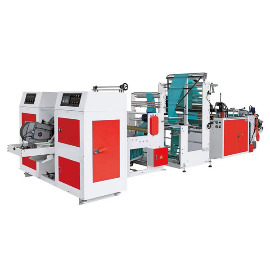
Plastic Bag Making Machine
Perforation quality control: The tear strength is measured by a tensile tester that pulls the film across the perforation. The acceptable range is specified (e.g., 1-3 N). The machine can have an in-line tester that automatically measures the tear force and adjusts the perforation depth. The perforation blade wears and must be replaced periodically; the machine tracks the usage and alerts for replacement. The blade alignment is critical; misalignment causes uneven perforation, leading to torn bags.
Winding quality: The roll must have consistent density and smooth edges. The winding spindle's surface finish and the pressure roller's force affect the roll's tightness. The machine may have a "dancer" that maintains tension during roll changes. The cut-off knife must produce a clean edge; dull knives cause jagged cuts. The roll is then ejected and conveyed to packaging.
Coreless winding technology: This requires the film to have sufficient stiffness to support itself without a core. The winding mandrel is tapered, and after winding, the roll is pushed off. The machine's tension control is critical to prevent the inner layers from collapsing. Some machines use a "fly" knife that cuts the roll while it is still rotating, reducing speed loss. By optimizing perforation and roll winding systems,
flat bag making machines produce high-quality garbage bag rolls that meet consumer expectations for ease of use and reliability.