Garbage Bag Making Machine Technical Deep Dive: Coreless Winding and Roll Density Control
Garbage bag making machines often produce bags on rolls (coreless or with a core) for residential and commercial use. The coreless winding process eliminates the cardboard core, reducing cost and waste. The winding station consists of a winding spindle (mandrel) that rotates, pulling the continuous chain of perforated bags onto itself. The film tension is the primary factor controlling roll density. Too high tension causes the bags to stick together or the roll to become too tight, making it difficult to tear off; too low tension produces a loose roll that unravels. The tension is controlled by a dancer roller and a servo motor on the winding spindle. The tension setpoint is adjusted based on the film thickness and bag size. As the roll grows in diameter, the spindle speed is reduced to maintain constant linear speed. The machine uses a diameter calculation (based on film length and thickness) to estimate the roll diameter and adjust speed accordingly. The winder also includes a pressure roller that applies a controlled force on the outside of the roll, pressing the layers together to achieve uniform density. The pressure is adjusted as the roll grows. The winding process is monitored by a roll density gauge (e.g., a laser or ultrasonic sensor) that measures the roll's hardness; if the density deviates, the tension or pressure is adjusted automatically.
Perforation and roll cutting: The bags are separated by perforations made earlier in the machine. The winding station also includes a cut-off knife that severs the roll when it reaches the desired number of bags or roll diameter. The cut-off must occur precisely at a perforation line to allow easy separation of the roll. A sensor counts the bags or measures the roll diameter; when the setpoint is reached, the cut-off knife engages, and the completed roll is ejected onto a conveyor. The ejection mechanism uses a pusher that slides the roll off the mandrel. The mandrel may be tapered or have an air-release feature to facilitate removal. The cut-off knife must be sharp and synchronized with the winding speed to produce a clean edge. Some machines use a "flying" knife that cuts while the roll is still rotating, minimizing speed loss.
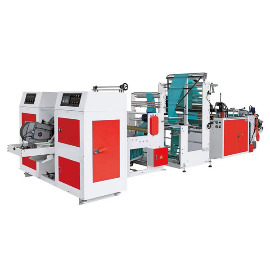
Plastic Bag Making Machine
Roll density optimization: The optimal roll density is a balance between compactness and tearability. For thin films (10-20 microns), lower density is needed to prevent sticking; for thick films (50+ microns), higher density is acceptable. The machine's control system uses a profile that varies the tension during winding: the initial layers (core) may have higher tension to create a firm core, while the outer layers have lower tension to reduce stress. This is called "tapered tension" winding. The profile is stored in a recipe. The pressure roller's force is also profiled. Some machines use an active dancer that measures the film's elastic modulus and adjusts tension accordingly.
Quality control: The roll's integrity is checked by visual inspection for flatness, edge alignment, and density. The tear force is measured by pulling a bag from the roll; if it exceeds a limit, the perforation strength is adjusted. The machine's control system logs the winding parameters and roll quality data for traceability.
Maintenance: The winding mandrel must be kept clean and free of film residue. The pressure roller's bearings require lubrication. The cut-off knife needs sharpening. The dancer and tension sensor require calibration. By optimizing coreless winding and roll density control,
garbage bag making machines produce high-quality, user-friendly rolls that meet consumer expectations for convenience and reliability.