High Speed Bag Making Machine Technical Deep Dive: Mechanical Dynamics and Vibration Damping
High speed bag making machines operating above 200 bags per minute (BPM) face significant challenges related to mechanical dynamics, primarily vibration and resonance. At high speeds, the inertial forces of reciprocating and rotating components (sealing bars, cutters, punch units) generate periodic excitations that can cause the machine frame and components to vibrate at their natural frequencies, leading to seal defects, mis-registration, accelerated wear, and excessive noise. The critical speed of the machine is the rotational frequency at which the excitation frequency coincides with a natural frequency of the system. For a machine running at 250 BPM (4.17 Hz), the fundamental excitation frequency is 4.17 Hz, but harmonics (2x, 3x, etc.) can excite higher modes. The machine's main shaft, connecting rods, and sealing bar linkages have natural frequencies that must be shifted well above the operating frequency range. Finite element analysis (FEA) is used to model the machine's structure and identify the modal frequencies. The goal is to design the frame and components such that the lowest natural frequency is at least 1.5 times the maximum operating frequency (6.25 Hz for 250 BPM). This is achieved by increasing stiffness (using thicker steel sections, cross-bracing) and reducing mass (using aluminum alloys for moving parts).
The sealing bar mechanism is the primary source of vibration. In a traditional cam-driven machine, the bar's acceleration profile has a high jerk (rate of change of acceleration) due to the cam's geometry, causing shock pulses. These pulses excite the structure. To mitigate, high-speed machines use servo motors with electronic cams that can generate smooth S-curve acceleration profiles, significantly reducing jerk. The servo also allows for active vibration control – the motor torque can be modulated to cancel out disturbances. The bar's mass is minimized by using hollow aluminum bars with optimized cross-sections. The guide system for the bar uses linear bearings with low friction and high damping, often with preload to eliminate backlash. The connecting linkages are designed with lightweight materials and balanced to reduce unbalanced forces. For rotary cutters, the blade and anvil roll must be dynamically balanced to avoid eccentricity-induced vibration; balance grades G2.5 or better are typical.
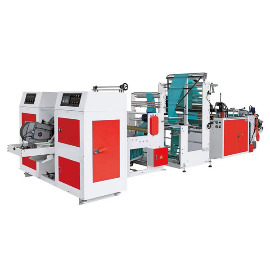
Plastic Bag Making Machine
Damping is crucial to dissipate vibration energy. Passive damping uses materials like viscoelastic compounds applied to the frame or rubber mounts between the machine and the floor. The floor mounts are tuned to have a natural frequency below the machine's operating frequency to isolate vibration. Active damping uses actuators (piezoelectric or electromagnetic) that apply counter-forces based on accelerometer feedback. This is more effective but costly. Some machines employ tuned mass dampers – auxiliary masses attached to the frame with springs and dampers that resonate out of phase with the machine's vibration, canceling it. The effectiveness of damping is measured by the logarithmic decrement or the damping ratio; a damping ratio of 0.1-0.2 is typical for passive systems, while active systems can achieve ratios above 0.5.
Vibration measurement and monitoring: Accelerometers are mounted on the sealing bar, frame, and cutter to measure acceleration in multiple axes. The data is processed to identify frequency components; if a component matches a natural frequency, corrective action is taken (e.g., adding mass, changing stiffness, or adjusting speed). The vibration level is expressed as velocity (mm/s RMS) or acceleration (m/s²). For high-speed machines, the vibration velocity should be below 2 mm/s RMS for smooth operation. If the vibration exceeds 5 mm/s, quality issues are likely. The monitoring system can alert operators to abnormal vibration, indicating wear (e.g., bearing defects) or imbalance.
Frame design: The machine frame is typically a welded steel structure with ribs and gussets. The cross-section of the main beams is calculated to maximize stiffness-to-weight ratio. The foundation must be a heavy concrete block with mounting bolts; the foundation's mass should be at least 3-5 times the machine's mass to provide inertia. For very high speeds (above 300 BPM), the machine may be mounted on a baseplate that is vibration-isolated from the floor using air springs or coil springs with hydraulic dampers.
By optimizing mechanical dynamics and implementing effective damping,
high speed bag making machines can achieve stable operation at speeds exceeding 250 BPM, maintaining seal quality and machine longevity. Continuous vibration monitoring and predictive maintenance ensure early detection of mechanical issues, preventing catastrophic failures and maximizing production uptime.