High Speed Bag Making Machine Technical Deep Dive: Thermal Management for High-Speed Sealing
At high production speeds (200+ BPM), the sealing bars in a bag making machine are subjected to intense thermal cycling. Each cycle, the bar contacts the film, transferring heat to melt it, then disengages and cools slightly before the next contact. The average power required to maintain the sealing temperature is proportional to the cycle rate and the film's heat absorption. For a 1200 mm wide bar sealing 50-micron LDPE at 250 BPM, the required heating power is approximately 3-5 kW. The challenge is that the bar's temperature fluctuates significantly during the cycle – it can drop by 10-20°C during the dwell (when heat is transferred to the film) and must recover within 100-200 ms before the next cycle. If the recovery is insufficient, the seal temperature drops, causing weak seals (cold seals). Conversely, if the controller overshoots, the film burns. Therefore, thermal management involves fast-responding heating elements, high-thermal-conductivity bars, and advanced control algorithms with feed-forward compensation.
Heating elements for high-speed machines are typically cartridge heaters with high watt density (15-25 W/cm²) embedded close to the sealing surface. They have low thermal mass, allowing rapid temperature changes. The bar material is copper (thermal conductivity 401 W/m·K) or a copper-aluminum composite, to quickly distribute heat from the heaters to the surface. The bar's surface is coated with a thin (0.1-0.2 mm) PTFE coating to prevent sticking; however, the coating adds thermal resistance. Some high-speed bars use a ceramic coating with better conductivity. The heater control uses a PID algorithm with a feed-forward term that anticipates the temperature drop based on the cycle rate. The feed-forward signal is proportional to the speed; when the machine accelerates, the controller increases power in advance, reducing the temperature dip. The controller's update rate must be at least 1 kHz to respond to the fast cycles.
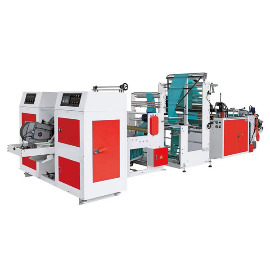
Plastic Bag Making Machine
Cooling is equally important. After the seal, the film must be cooled to solidify the bond; otherwise, it may deform or stick to subsequent rollers. In high-speed machines, the cooling is achieved by passing the sealed area over a water-cooled chill roller. The chill roller's surface temperature is maintained at 10-20°C, and it extracts heat rapidly. The cooling capacity must match the heat input – for a 5 kW sealing power, the cooling system must remove at least 4 kW to prevent heat accumulation. The chill roller is often driven at a slightly higher peripheral speed to maintain film tension. The water circulation system has a chiller with a temperature controller. If the cooling is insufficient, the seal may be weak or the bag may stick to the sealing bar, causing jams. Some machines use forced air cooling in addition to chill rollers, especially for thick films.
Temperature profiling across the sealing bar is critical at high speeds. The bar ends lose heat faster due to radiation and convection, creating a temperature gradient. This gradient causes uneven seal strength – the center is stronger, the edges weaker. To compensate, the bar is divided into multiple heating zones (3-5 zones) with independent PID controllers. The zone temperatures are set slightly higher at the ends (e.g., +5°C) to offset heat loss. The controllers use thermocouples placed at the end of each zone. The zone widths are optimized based on heat transfer simulations. Some machines use a thermal imaging camera to monitor the bar's surface temperature in real-time and adjust the zone setpoints automatically – a closed-loop thermal control system.
Another challenge is thermal expansion of the bar and frame. At high speeds, the bar expands longitudinally, which can cause misalignment with the film edge. The expansion is about 0.01 mm per degree per meter; a 1.2 m bar heated from 20°C to 160°C expands about 1.7 mm. To compensate, the bar is mounted with expansion slots or using a floating mount that allows lateral movement. The machine's control system tracks the bar temperature and adjusts the cut length and registration accordingly to compensate for the expansion effect on bag length.
By implementing advanced thermal management strategies – fast heaters, high-conductivity bars, feed-forward control, multiple zones, and efficient cooling –
high speed bag making machines can maintain consistent seal temperatures even at 250+ BPM, producing strong, uniform seals on a variety of films. The thermal system also contributes to energy efficiency by optimizing heater power and reducing waste heat, lowering operating costs and improving the machine's carbon footprint.