Hydraulic Bag Making Machine Technical Deep Dive: Heat Management and Cooling in Hydraulic Systems
Hydraulic systems in bag making machines generate significant heat due to pressure losses in valves, friction in pumps, and mechanical losses in cylinders. The heat raises the oil temperature, which lowers viscosity, reduces lubrication, accelerates seal degradation, and can cause valve malfunction. For consistent sealing force, the oil temperature must be maintained within a narrow range (typically 40-55°C). Heat generation is estimated from the system's input power: for a 50-ton hydraulic system with 30 kW pump motor, about 10-15 kW of heat is generated, depending on the duty cycle. The heat load is transferred to the oil, which must be removed by a cooler. The cooler can be air-cooled (finned heat exchanger with fans) or water-cooled (plate or shell-and-tube heat exchanger). Air-cooled systems are simpler but larger and noisier; water-cooled systems are more compact but require a cooling water supply and have maintenance for water quality. The cooler's capacity is calculated from the heat load and the desired temperature drop: Q = m·cp·ΔT. For a 15 kW load and a 10°C temperature drop, the oil flow rate must be about 25 L/min for a typical oil specific heat of 2 kJ/kg·K.
The cooling system is controlled by a thermostat that switches the cooler on when the oil temperature exceeds a setpoint (e.g., 50°C). For water-cooled systems, a proportional valve controls the water flow. The oil should be filtered before the cooler to prevent fouling. The reservoir (tank) also acts as a heat exchanger by radiating heat; its size is typically 2-3 times the pump flow rate (to allow de-aeration). The tank's surface area is increased by internal baffles. The tank may have a level sensor and a temperature probe. In cold environments, a heater may be needed to warm the oil to a minimum viscosity for startup.
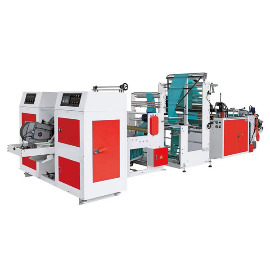
Plastic Bag Making Machine
Thermal expansion and its effects: As the oil temperature rises, it expands, and the pressure may increase if the system is closed. An accumulator with a gas bladder compensates for volume changes. The seals and hoses also expand; the system must accommodate this without leaks. The control system can use temperature compensation in the pressure control algorithm: the pressure setpoint is adjusted slightly based on oil temperature because viscosity affects the pressure drop in the valves, hence the actual force applied. For example, at higher temperatures (lower viscosity), the same valve opening yields higher flow, potentially increasing the cylinder speed. Therefore, the control logic may reduce the valve command at high temperature to maintain consistent speed.
Cooler sizing example: For a 30 kW hydraulic system with 50% duty cycle, the average heat load is 15 kW. If the maximum ambient temperature is 40°C and the maximum oil temperature allowed is 55°C, the cooler must have a capacity of at least 15 kW at 15°C difference (oil-to-air). An air-cooled cooler with a fan capacity of 1000 CFM and a fin area of 20 m² may be needed. Water-cooled coolers are more efficient; a plate heat exchanger with a water flow of 10 L/min at 25°C inlet can remove 15 kW with a small size. The water circuit requires a cooling tower or chiller, adding to the plant utilities.
Monitoring and diagnostics: The oil temperature is continuously monitored; an alarm is triggered if it exceeds 60°C, indicating a cooler failure or excessive load. The differential pressure across the cooler is also monitored; an increase indicates fouling. The system can log temperature trends to schedule cleaning. Proper heat management ensures that the
hydraulic bag making machine operates with consistent performance, extending the life of hydraulic components and maintaining seal quality. The thermal stability of the oil also ensures that the sealing force remains uniform across production shifts, reducing defects and improving overall productivity.