Hydraulic Bag Making Machine Technical Deep Dive: Hydraulic System Design and Pressure Control
Hydraulic bag making machines utilize pressurized hydraulic fluid to actuate heavy-duty sealing and cutting mechanisms, providing forces up to 50 tons that are unattainable with pneumatic or servo systems. The hydraulic system consists of a power unit (motor-driven pump, reservoir, filters, cooler), control valves (directional, proportional, pressure relief), and actuators (cylinders). The pump is typically a variable-displacement axial piston pump, which adjusts its output flow based on the load, reducing energy consumption during idle periods. The pump's maximum pressure is set by a pressure relief valve, usually 200-250 bar. The proportional valves enable precise control of cylinder speed and force by modulating the flow and pressure. The system's dynamic response must be fast enough for the sealing cycle – a typical hydraulic sealing cycle includes: fast approach (high flow, low pressure), contact (pressure build-up), dwell (constant pressure), and retract (flow reversal). The response time from command to full force is typically 50-150 ms. The pressure control accuracy is ±2-5 bar, sufficient for sealing thick films (100-300 microns).
The sealing cylinder's bore and rod diameter determine the force output: Force = Pressure × Area. For a 50-ton force at 250 bar, the cylinder piston area must be 200 cm² (diameter ~160 mm). The cylinder stroke is typically 20-50 mm for sealing bars. The cylinder is double-acting, with regenerative or differential circuits to reduce cycle time. The sealing bar is attached to the cylinder rod; its mass is up to 100 kg. The hydraulic system must provide enough flow to move the bar at the required speed – for a 200 mm stroke in 0.5 seconds, the flow rate is about 24 L/min. The pump's flow capacity is sized for the peak demand, but the average flow is lower. An accumulator (pressurized gas bladder) can supply peak flow, allowing a smaller pump and reducing energy consumption. The accumulator also dampens pressure pulsations and provides emergency pressure in case of pump failure.
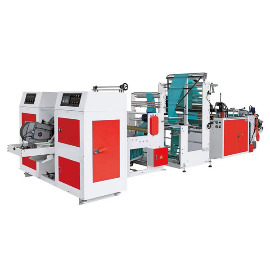
Plastic Bag Making Machine
Pressure control is achieved by a proportional pressure-reducing valve that regulates the pressure applied to the cylinder. The valve receives a command signal (0-10V or 4-20mA) from the PLC, which is based on the required sealing force. A pressure transducer on the cylinder provides feedback to the PLC, which adjusts the valve to maintain the setpoint. The PID gains are tuned to balance speed and accuracy. For multi-layer films or uneven thickness, the pressure may be adjusted dynamically during the dwell – e.g., a slight increase to compensate for thickness variation. The system also includes a pressure relief valve to limit maximum pressure for safety. The hydraulic oil must be maintained at 40-60°C; a cooler (water or air) regulates the temperature. Viscosity changes with temperature affect pressure control; therefore, a temperature sensor is integrated, and the control algorithm compensates for viscosity variations.
Energy efficiency: Variable-displacement pumps with load sensing reduce power consumption by supplying only the flow and pressure needed. When the machine is idle, the pump swashes to near-zero displacement, consuming only a few kW. In contrast, fixed-displacement pumps with relief valves waste energy as heat. The hydraulic system's overall efficiency is typically 70-80%, lower than servo drives but acceptable for heavy-duty applications where high force is needed. The hydraulic fluid must be filtered continuously to maintain cleanliness (ISO 16/13 or better) to prevent valve sticking and wear. The filters have replaceable elements and differential pressure indicators.
Maintenance: The hydraulic oil must be sampled periodically for contamination and acidity; it should be replaced every 2-3 years. Seals in cylinders and valves wear; leaks are the most common issue. The accumulator's pre-charge gas pressure must be checked quarterly. The pump's bearing and coupling require inspection. By designing the hydraulic system with robust components and precise control,
hydraulic bag making machines deliver high-force, reliable sealing for the most demanding industrial sacks, ensuring consistent seal strength and long equipment life.