Non Woven Bag Making Machine Technical Deep Dive: Handle Attachment and Folding Automation
Non woven bags often include handles – either cut from the same fabric (integral handles) or attached as separate strips. Handle attachment is a complex operation that requires precise alignment and welding. Separate handles are fed from a roll or a stack, cut to length (typically 400-600 mm, width 20-50 mm), and positioned on the bag body. The handle ends are welded to the bag using ultrasonic or thermal welding. The handle feeding system uses servo-driven rollers to advance the handle material, with a rotary cutter for clean ends. The handle placement is guided by a vision system that detects the bag position; the handles are placed symmetrically. The welding of handles is done by a separate set of ultrasonic horns and anvils, often with multiple heads to weld both sides simultaneously. The welding time is 0.2-0.4 seconds, and the amplitude is similar to the side seam welding. The handle weld must be strong enough to support the bag's load (typically 5-10 kg). The machine's control system coordinates the handle feeding, cutting, placement, and welding with the bag making cycle. For high-speed machines (60-80 BPM), the handle attachment station is often a rotary turret with multiple welding heads to reduce cycle time.
Folding automation: Non woven bags are often folded flat for packing and shipping. The folding station folds the bag in half (or thirds) after welding. The folding is done by a series of folding plates and rollers that guide the bag into the desired fold. The fold must be precise to ensure uniform stack height. The folding station includes a creasing device (heated or cold) to set the fold line. The folded bags are then stacked and counted. The folding automation reduces labor and improves packaging density. The machine's control system adjusts the fold position based on bag size; quick-change folding plates enable rapid changeover. The folded bags are conveyed to a stacking unit that compresses and bundles them.
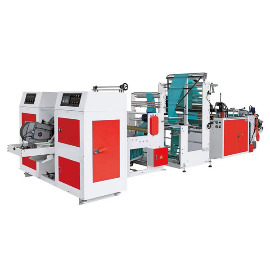
Plastic Bag Making Machine
Integration of handle attachment and folding: These stations are sequential. First, the handles are welded, then the bag is folded. The machine's timing must ensure that the handles are fully welded before folding to avoid distortion. The folding plates must avoid the handle area to prevent creasing the handles. The machine's HMI allows the operator to set handle length, position, and fold style. The system includes sensors to detect handle presence; if a handle is missing, the bag is rejected before folding.
Quality control: The handle weld strength is tested by a pull test; the machine can have an in-line pull tester that applies a force to the handle and measures the displacement. The handle alignment is inspected by vision; if the handles are asymmetrical, the machine adjusts the placement. The fold quality is checked by measuring the stack height and edge alignment.
Maintenance: The handle feeding rollers and cutter require regular cleaning. The ultrasonic horns for handle welding need the same care as the main welding horns. The folding plates must be kept clean and free of scratches. The sensors for handle detection need calibration. By automating handle attachment and folding,
non woven bag making machines produce high-quality, ready-to-use reusable bags at high speeds, meeting the demand for eco-friendly retail packaging.