Paper Bag Making Machine Technical Deep Dive: Creasing and Folding Precision for Square Bottoms
Paper bags with square bottoms require precise creasing and folding to achieve a flat, stable base. The creasing station uses a pair of rollers with male and female profiles (or a single creasing wheel) that compress the paper along the fold lines. The crease depth is controlled by the gap between the rollers; a deeper crease makes folding easier but weakens the paper. The optimal crease depth is about 50-70% of the paper thickness. The creasing rollers are made of hardened steel and are adjustable for different paper thicknesses. The crease lines must be parallel to the bag edges; any skew causes the bottom to be asymmetrical. The paper is then folded by a series of folding plates and tucking blades. The folding sequence is complex: the bottom flaps are folded in a specific order (often the side flaps first, then the end flaps). The folding plates are precision-machined and coated to reduce friction. The folding timing is critical; the paper must be stationary during folding to avoid misalignment. The machine uses a servo-driven folder that moves the plates into position. The fold accuracy is ±0.5 mm. After folding, the flaps are pressed and glued. The bottom is then cooled or dried to set the glue.
Alignment control: The crease position relative to the side seals and the print is maintained by a registration system. A print mark or a pre-printed line is detected by a sensor, and the paper feed is adjusted to position the crease correctly. For unprinted bags, a mechanical edge guide is used. The creasing rollers are mounted on a slide that allows fine adjustment of the crease position. The machine's control system stores recipes for different bag sizes, including crease depth, fold order, and glue amount. The changeover for different sizes involves replacing folding plates and adjusting the creasing gap; quick-change systems reduce downtime.
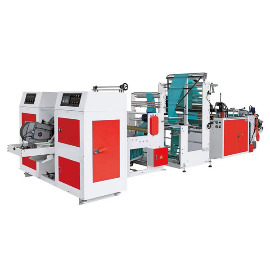
Plastic Bag Making Machine
Folding plate design: The folding plates are made of polished steel or aluminum with a low-friction coating. The plate geometry determines the fold shape; for a block bottom, the plates have a series of angled surfaces that guide the paper. The plates are adjustable for different bottom depths. The plates are heated slightly (40-50°C) to reduce friction and improve fold retention. The pressure of the folding plates is controlled by springs or air cylinders; excessive pressure can cause paper scoring. The folder station includes sensors to detect if a flap is missing or mis-folded; a mis-fold triggers a reject.
Quality control: The bottom flatness is checked by placing the bag on a flat surface and measuring the gap. The bottom seal strength is tested by peel. The crease quality is inspected for any cracking or fiber damage. The machine's vision system can inspect the bottom shape and flag any asymmetry. The control system logs the crease depth and fold timing for each batch.
Maintenance: The creasing rollers must be kept clean and free of paper dust; the bearings require lubrication. The folding plates need regular cleaning to remove glue residue. The sensors for alignment require calibration. By achieving creasing and folding precision,
paper bag making machines produce high-quality, square-bottom bags that stand upright, ideal for retail and food service applications where presentation and stability matter.