Plastic Bag Making Machine Technical Deep Dive: Mechanical Design and Kinematics
The mechanical design of a plastic bag making machine is the foundation of its performance, directly influencing maximum speed, bag quality, and long-term reliability. At the core of the machine's kinematics is the conversion of rotary motion from the main drive into the linear reciprocating motions required for sealing, cutting, and punching operations. Traditional machines rely on mechanical cam systems, where a single motor drives a main shaft with eccentric cams that actuate the sealing bars, cutting blades, and film pull rollers through linkages and levers. The cam profiles are carefully designed to provide smooth acceleration and deceleration, minimizing shock and vibration at high speeds. Key cam parameters include rise angle, dwell period, and return angle, which together define the motion cycle. For a typical bottom-seal machine running at 250 cycles per minute, the total cycle time is 240 milliseconds, with sealing requiring a 40-millisecond dwell, cutting 20 milliseconds, and film advance 150 milliseconds. The remaining time is allocated to acceleration and deceleration phases to reduce wear on bearings and linkages. Advanced machines employ harmonic drives or cycloidal reducers to achieve backlash-free motion, essential for maintaining registration accuracy within ±0.2 mm.
Modern high-speed bag making machines increasingly adopt servo motor technology for independent axis control, replacing mechanical cams with electronic cam profiles. Each motion axis – film pull, sealing bar, cutting blade, and punching unit – is driven by its own servo motor, synchronized via a high-speed motion controller using real-time Ethernet (EtherCAT or Profinet). This decoupling allows for dynamic adjustment of each axis's timing and stroke length without mechanical reconfiguration. For example, the sealing bar can be programmed to approach the film with a soft touch to reduce impact, then apply full pressure during the dwell, and retract rapidly to minimize cycle time. The film pull axis uses a servo-driven nip roller with a direct drive, eliminating gear backlash and enabling precise acceleration profiles that reduce film tension spikes. The electronic cam allows for "flying" cuts, where the cutting knife is synchronized with the film speed to cut on-the-fly, eliminating the need for a separate dwell period and increasing the maximum cycle rate by 15-20%. Servo systems also provide real-time feedback on torque and position, enabling condition monitoring and predictive maintenance.
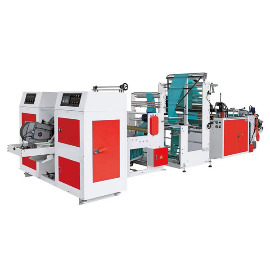
Plastic Bag Making Machine
The dynamic behavior of the sealing bar is particularly critical, as it must apply precise pressure and heat for a controlled duration. The sealing bar's mass and inertia directly affect the achievable acceleration and deceleration rates. Lightweight materials such as aluminum alloys or carbon-fiber composites are used for the bar structure, while the heating elements are embedded in a copper or brass face plate for uniform thermal distribution. The servo motor driving the sealing bar must have sufficient torque to overcome the inertia at high speeds – typically 5-10 Nm for a 1200 mm wide bar. The motion profile is optimized using S-curve acceleration to reduce jerk, which minimizes vibration and extends the life of linear guides and bearings. Finite element analysis (FEA) is employed to simulate the bar's deflection under load, ensuring that the seal pressure remains uniform across the full width. Temperature sensors embedded in the bar provide feedback to the PID controller, which adjusts heating power in real-time to compensate for heat loss during the rapid cycles.
The cutting mechanism, whether rotary or guillotine, also demands careful kinematic analysis. Rotary cutters use a rotating cylindrical blade that continuously shears the film against an anvil roller. The angular velocity of the cutter must be synchronized with the film speed such that the tangential velocity matches the film feed speed to avoid drag or bunching. The cutter's servo motor follows an electronic cam profile that adjusts the phase angle based on registration feedback. For guillotine cutters, the vertical motion is often driven by a servo-driven crank mechanism, where the crank radius and connecting rod length determine the cutting stroke. The cutting force is a function of film thickness and material shear strength; for 100-micron HDPE, the required force is approximately 200-400 N per meter of width. The blade clearance is set to 0.02-0.05 mm, and wear compensation is applied through software to maintain consistent cut quality as the blade dulls.
Vibration analysis is essential for high-speed machines, as resonance can cause seal defects and excessive noise. The machine frame's natural frequency must be at least 1.5 times the operating frequency to avoid resonance. Modal analysis using FEA helps identify weak points, and stiffening ribs or damping materials are added as needed. Active damping systems using piezo-electric actuators are emerging in premium machines to cancel vibrations at specific frequencies. Additionally, the film tension control system, which uses load cells and a dancer roll, must have a bandwidth exceeding the machine's cycle frequency to regulate tension effectively. A tension controller with a high-gain PID algorithm, tuned to the film's elasticity, ensures that tension variations are suppressed within 2% of setpoint. By understanding and optimizing these mechanical and kinematic aspects, engineers can design
plastic bag making machines that achieve higher speeds, better accuracy, and longer service life, pushing the boundaries of production efficiency.