Plastic Bag Making Machine Technical Deep Dive: Thermal System and Seal Integrity
The thermal system of a
plastic bag making machine is responsible for delivering precise, controlled heat to the sealing bars to create strong molecular bonds in the film. The quality of the seal – its strength, consistency, and appearance – directly depends on the ability to maintain the optimal temperature profile across the sealing bar and to apply it for the correct dwell time. The thermal system comprises heating elements (cartridge, tubular, or band heaters), temperature sensors (thermocouples or RTDs), a PID controller, and cooling mechanisms (air or water). The heat transfer from the heater to the film occurs through conduction – the heater warms the sealing bar, which contacts the film layers and conducts heat into them. The thermal resistance of the sealing bar material (copper or aluminum) and its interface with the film are critical parameters. Copper bars offer high thermal conductivity (401 W/m·K) but are heavier and more expensive, while aluminum (205 W/m·K) provides a good balance. The bar surface is coated with a non-stick material such as Teflon or silicone to prevent film adhesion, but this coating adds thermal resistance – typically 0.1-0.3 K/W, which must be compensated by higher bar temperatures.
Temperature uniformity across the sealing bar is essential to ensure consistent seal strength along the entire bag width. Thermal profiling – using multiple thermocouples at different points along the bar – reveals temperature gradients caused by heat loss at the ends, uneven heater placement, or air flow. To achieve uniform temperature (within ±2°C), heaters are zoned, with independent PID control for each zone. The controller adjusts power to each heater based on feedback from its thermocouple, compensating for heat loss. The dwell time is the duration that the bar remains in contact with the film; for a given temperature, longer dwell increases seal strength but reduces production speed. The relationship between temperature, dwell time, and seal strength is governed by the Arrhenius equation for polymer diffusion: higher temperature reduces the activation energy needed for molecular chain entanglement, allowing shorter dwell times. However, exceeding the film's degradation temperature causes thermal degradation – evident as yellowing, brittleness, or burning. For LDPE, the optimal sealing window is 120-160°C with a dwell of 0.2-0.5 seconds; for HDPE, 160-200°C with 0.3-0.6 seconds; for PLA, 100-140°C with 0.4-0.8 seconds.
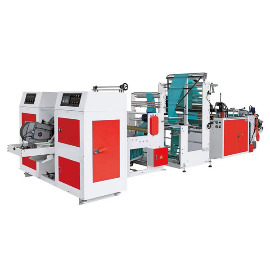
Plastic Bag Making Machine
Advanced thermal management includes predictive control algorithms that anticipate temperature changes based on the machine's cycle rate. When speed increases, the sealing bar has less time to recover heat between cycles, so the controller must increase power in advance – a technique called feed-forward control. Thermal models that simulate the bar's heat capacity and heat loss to the environment are used to calculate the required power profile. Some machines incorporate heated cooling plates that maintain the film at a base temperature to reduce the thermal shock during sealing. For thick films or multi-layer laminates, a pre-heating zone may be added before the main seal to raise the film temperature gradually, reducing the required dwell time at the main seal. Infrared heating is sometimes used for pre-heating, offering fast response but less uniformity than contact heating.
Seal integrity is verified by measuring the seal's peel strength and burst strength. Peel strength is tested by peeling the seal apart at a constant rate and measuring the force required – typically 20-30 N/25mm for good seals. Burst strength is tested by pressurizing the bag until it bursts. The seal failure mode should be film tearing, not seal delamination, indicating that the seal is stronger than the base film. Statistical process control (SPC) charts are used to monitor seal strength over time, with control limits set at ±3 sigma. Any drift triggers an investigation – common causes include thermocouple drift, heater degradation, pressure loss, or film thickness variation. Routine calibration of thermocouples against a certified reference is performed monthly to ensure accuracy within ±1°C.
Cooling is as important as heating, as the seal must be solidified before the bag is handled or stacked. Insufficient cooling leads to seal distortion, weakening, or sticking to the sealing bar. Chill rollers, typically water-cooled, are placed immediately after the sealing station to extract heat rapidly. The cooling rate affects the crystallinity of the polymer in the seal zone – slower cooling allows more ordered crystals, which may improve seal toughness but requires longer cooling times. For high-speed machines, forced air cooling or refrigerated chill rollers are used to achieve fast cooling. The thermal system's overall energy efficiency is improved by insulating the sealing bars and recovering waste heat from the cooling water for other plant uses. Advanced machines use a thermal imaging camera to monitor the seal temperature profile in real-time, providing closed-loop feedback to the heaters. By mastering the thermal dynamics, bag making machine engineers can achieve high-speed production with consistent, strong seals across a wide range of film materials, meeting the rigorous demands of modern packaging applications.