Plastic Bag Making Machine for Packaging Technical Deep Dive: In-line Leak Testing and Quality Assurance
In packaging applications, seal integrity is paramount to prevent contamination and maintain product freshness. In-line leak testing is increasingly integrated into plastic bag making machines to detect pinholes, weak seals, and incomplete seals in real-time, before the bags are packaged or shipped. The most common non-destructive method is pressure decay testing: a sealed bag is placed in a chamber, and a vacuum or pressure is applied; the change in pressure over a short time (e.g., 1-2 seconds) indicates a leak. For high-speed lines, the testing must be fast (under 100 ms per bag). This is achieved by using a small test head that contacts the bag seal area and applies a localized pressure differential. The test head is mounted on a servo-driven axis that moves with the bag during the test (for continuous motion) or operates during a dwell. The pressure sensor has a resolution of 0.1 kPa, and the test sensitivity can detect leaks as small as 0.01 mm. The test results are processed by a controller; if a leak is detected, the bag is rejected by an air blast or a mechanical diverter. The rejection system must be fast enough to remove the defective bag without disrupting the line. The leak tester is calibrated daily using reference leaks.
Another method is the "bubble test" where the sealed bag is submerged in water and air pressure is applied; bubbles indicate a leak. This is slower and not suitable for high-speed in-line use but may be used for random sampling. For foil-based bags, a high-voltage spark test can detect pinholes by passing a high-voltage electrode over the film; any pinhole causes a spark that is detected. This method is non-contact and very fast, suitable for high-speed lines. However, it requires careful shielding to avoid electrical hazards. The spark test is sensitive to film thickness and moisture content, and it only detects holes, not weak seals. Therefore, it is often combined with pressure decay testing. Some machines use a combination of vision inspection (for seal width and appearance) and leak testing for comprehensive quality assurance.
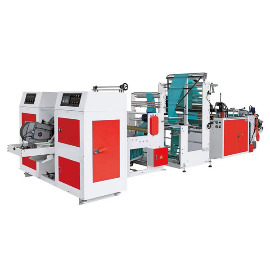
Plastic Bag Making Machine
Integration with the bag making process: The leak tester is typically positioned after the sealing station, before the stacking or winding. The bags are still in a continuous web or separated; the tester must handle both formats. For continuous web, the tester can be a non-contact type (e.g., spark) that scans the film as it passes. For separated bags, a robotic gripper may pick each bag and place it on the test station. The speed of the tester must match the bag maker's speed; if the tester is slower, it becomes a bottleneck, requiring multiple test heads in parallel. The machine's control system synchronizes the tester with the bag maker, and any reject signal is sent to the rejection mechanism. The test data is logged for quality records and can be integrated with the MES system.
Quality assurance parameters: The leak test sensitivity is set based on the product's requirements (e.g., for sterile medical packaging, the leak limit is extremely low). The test cycle time includes sealing the test chamber, applying pressure, measuring, and venting. The pressure decay rate is monitored; a high decay rate indicates a leak. The machine's controller uses a statistical process control (SPC) chart to monitor the leak rate trend; a gradual increase may indicate seal bar wear or film changes. The machine can alert the operator to perform maintenance.
Rejection and handling: Rejected bags are diverted to a reject bin or conveyor. The rejection mechanism must be gentle to avoid damaging rejected bags (for later analysis) but fast to prevent blockages. The reject count is logged, and if it exceeds a threshold, the machine may stop automatically to force investigation. The rejected bags are often retained for root cause analysis, and their sealing parameters are recorded.
By implementing in-line leak testing and robust quality assurance, plastic bag making machines for packaging ensure that only hermetically sealed, defect-free bags reach the customer, protecting product integrity and brand reputation, and reducing the risk of costly recalls.