Recycled Bag Making Machine Technical Deep Dive: Seal Strength Compensation for Variable Film Properties
Recycled films have inherent variability in thickness, melt flow, and additive content due to mixed feedstock. This variability causes fluctuations in seal strength – a critical quality parameter. To compensate, bag making machines use adaptive sealing control systems. The machine is equipped with a seal strength tester (in-line peel or burst) that measures the seal strength on a sample bag (e.g., every 100 bags). The tester provides real-time feedback to the control system. If the seal strength deviates from the setpoint, the system adjusts the sealing temperature, pressure, or dwell time. The adjustment is based on a predictive model that correlates seal strength with temperature, pressure, and film thickness. The model is updated continuously using machine learning. For example, if the seal strength is low, the temperature is increased by 2°C, or the pressure is increased by 0.5 bar. The adjustment is gradual to avoid over-correction. The system also uses feed-forward compensation based on the film thickness measured by an online gauge; thicker film requires higher temperature or longer dwell. The control algorithm uses a model predictive control (MPC) that anticipates changes in film properties.
Thickness compensation: The film thickness is measured by a beta, IR, or ultrasonic gauge. The thickness value is used to adjust the sealing parameters in real-time. For each thickness, a base temperature and dwell are calculated from a calibration curve. The machine's control system stores a thickness-temperature-dwell matrix. The thickness gauge is placed just before the sealing station. The gauge's signal is filtered to reduce noise. The compensation is applied to each bag individually; the machine's servo system can adjust the dwell time by changing the sealing bar's closing speed.
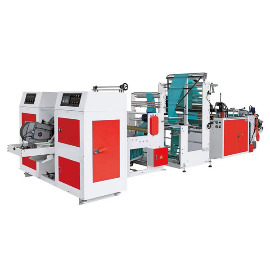
Plastic Bag Making Machine
Pressure compensation: Film thickness variations also affect the required sealing pressure. Thicker films require higher pressure to ensure intimate contact. The pressure is adjusted by a servo-controlled pneumatic regulator or a hydraulic proportional valve. The pressure setpoint is calculated from the thickness measurement. The pressure is monitored by a load cell; any deviation triggers an adjustment. The pressure compensation is combined with temperature and dwell compensation to maintain seal strength.
Quality monitoring: The in-line seal tester provides data for SPC charts. If the seal strength variability exceeds the control limits, the machine alerts the operator for maintenance (e.g., cleaning the sealing bar or replacing the thermocouple). The system also logs the compensation adjustments, allowing engineers to analyze the film's batch-to-batch variability and work with suppliers to improve quality.
Maintenance: The in-line seal tester requires regular calibration with reference samples. The thickness gauge must be calibrated daily. The servo regulators for pressure and temperature need periodic checks. By implementing adaptive seal strength compensation,
recycled bag making machines consistently produce acceptable seals despite variable film properties, reducing rejects and enabling the use of higher percentages of recycled content without compromising quality.