Sack Making Machine Technical Deep Dive: Heavy-Duty Sealing for Woven Polypropylene
Sack making machines for woven polypropylene (PP) fabric operate under fundamentally different principles from those for film. Woven PP fabric is a mesh of interwoven tapes, which is not inherently heat-sealable because the tapes do not melt uniformly. To create a seal, the fabric must be coated with a thin layer of polyethylene (PE) or polypropylene copolymer, which melts under heat and fuses the layers. The sealing process typically uses hot air, heated bars, or a combination, applied to the coated surface. Hot air sealing is most common for heavy-duty sacks: a stream of hot air (200-300°C) is directed onto the coating, melting it, and then pressure rollers press the layers together to form a bond. The seal strength depends on the coating weight, hot air temperature, air flow rate, and the pressure applied by the rollers. Typical coating weights are 20-40 g/m²; higher coatings yield stronger seals but increase material cost. The hot air temperature must be precisely controlled to melt the coating without degrading the PP tapes – degradation causes brittle seals that fail under impact. The hot air nozzle design, including slot width and distance to the fabric, affects the heat transfer efficiency. Computational fluid dynamics (CFD) simulations are used to design nozzles that provide uniform temperature across the sack width.
The sealing pressure is applied by a pair of heated or unheated pressure rollers, which also pull the fabric through the sealing section. The nip pressure is typically 4-8 bar, applied by pneumatic cylinders. The rollers may be grooved to improve grip and prevent fabric slippage. The dwell time – the duration the fabric is under heat and pressure – is determined by the machine speed and the roller diameter. For a sack length of 800 mm and a speed of 40 sacks/min, the sealing time per sack is about 0.75 seconds. The heat must be sufficient to melt the coating in that time. The temperature setpoint is adjusted based on the coating's melt flow index and the ambient temperature. A closed-loop temperature controller maintains the hot air within ±5°C. Infrared thermometers monitor the fabric surface temperature after sealing to ensure it reaches the required melt temperature (typically 180-220°C for PE coating).
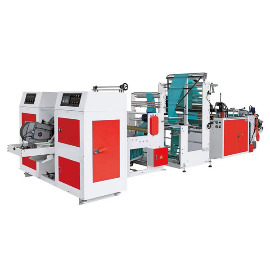
Plastic Bag Making Machine
Alternative sealing methods include impulse sealing (for PE-coated woven fabric) and ultrasonic sealing (for uncoated fabrics with added tie layers). Ultrasonic sealing uses high-frequency vibrations to generate heat internally within the fabric layers, eliminating the need for a coating. This is energy-efficient and produces clean seals, but the equipment is more expensive and slower. For uncoated woven PP, stitching is also used – a sewing head applies a double chain-stitch closure, which is strong but not airtight and requires thread consumption. Stitching is common for open-mouth sacks that will be sewn closed after filling. The choice of sealing method depends on the sack's end-use – for moisture-sensitive products like cement or chemicals, heat-sealed coated fabric is essential; for dry free-flowing goods like grains, stitching is acceptable.
Seal integrity testing for woven sacks includes peel strength, drop test, and permeability tests. Peel strength should be at least 10-15 N/25mm for adequate performance. The drop test simulates rough handling: a sack filled with test material is dropped from a height (1-2 meters) onto a hard surface, and the seal is inspected for failure. Permeability testing measures air leakage, which is critical for products that require dust-tightness. Failure analysis of weak seals often reveals insufficient coating coverage, uneven hot air distribution, or roller pressure misalignment. To address these, manufacturers use statistical process control (SPC) and adjust parameters based on real-time seal strength measurements from an in-line peel tester.
Recent innovations include servo-driven pressure rollers that can dynamically adjust pressure based on fabric thickness variations, and hot air systems with multiple independent zones to accommodate fabric density variations. Also, some
sack making machines now incorporate a pre-heating station to raise the fabric temperature before the main seal, reducing the required hot air temperature and saving energy. The hot air source can be electric or gas-fired; gas is more cost-effective for large lines but requires precise combustion control. By optimizing these sealing parameters, sack making machines can produce high-strength, reliable seals for heavy-duty packaging applications, ensuring product safety and reducing waste due to seal failure.