Sack Making Machine Technical Deep Dive: Valve Insertion and Block Bottom Formation
Valve sacks are specialized bags with a small opening (valve) at the top or bottom, through which the product is filled, after which the valve self-closes due to internal pressure. Producing valve sacks requires additional modules on the sack making machine: a valve paper or plastic tube feeding system, cutting, folding, and insertion station, and an adhesive applicator to secure the valve. The valve is typically made from a reinforced paper or a laminated film tube, cut to length, and inserted between the sack's layers at the corner. The insertion process must be precise – the valve must protrude into the sack's interior by a specific length (typically 20-50 mm) to ensure proper filling and sealing. The valve is glued to the sack's inner flaps using hot melt adhesive. The alignment tolerance is ±2 mm; misalignment causes filling issues or leakage. The valve insertion module is servo-driven, with independent axis control for feeding, cutting, and positioning. The module's cycle time must match the sack production rate – for a 40 sacks/min machine, each valve insertion takes about 1.5 seconds.
Block bottom formation creates a square, flat bottom on the sack, enabling it to stand upright and be stacked stably. This is achieved by folding the bottom of the tubular fabric into a rectangular shape, with overlapping flaps that are glued together. The process involves creasing the fabric along predetermined lines, folding the flaps inward, applying adhesive, and pressing the layers together. The folding station uses a series of folding plates and forming collars that progressively shape the bottom. The adhesive is typically hot melt or cold glue, applied by nozzles or rollers. The folding accuracy determines the bottom's flatness and strength. Uneven folds cause the sack to bulge or leak. The crease lines must be set exactly parallel to the sack's edges – a deviation of 1 mm can misalign the bottom. Advanced machines use laser or mechanical creasers with precise depth control. The bottom is then pressed by a heated or cold press roller to set the glue. The press time and force are critical for strong adhesion – typically 2-5 bar pressure for 0.5-1 second.
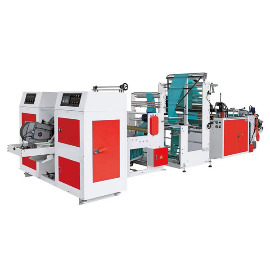
Plastic Bag Making Machine
Both valve insertion and block bottom formation require high-speed, precise mechanical synchrony with the main sack production line. The fabric movement is intermittent – the fabric is advanced, stopped for folding and gluing, then advanced again. The servo-driven axes handle this stop-start motion with S-curve profiles to minimize shock. The glue system must apply consistent amounts without dripping or clogging. Hot melt glue systems use heated hoses and nozzles, with temperature control to maintain viscosity. Cold glue systems use water-based adhesives, requiring drying time, which may slow the line. Some machines use a combined approach: hot melt for the main bond and cold glue for auxiliary flaps.
Quality control for valve sacks includes testing the valve opening size, positioning, and peel strength of the valve adhesive. A leak test is performed by applying air pressure to the sealed sack and measuring pressure drop. For block bottom sacks, the bottom's flatness is measured, and the seal strength of the bottom flaps is tested. Any deviation triggers an automatic reject mechanism. Vision inspection systems are increasingly used to check valve position and bottom fold symmetry in real-time, providing feedback to adjust the folding plates or valve insertion unit. Statistical process control monitors the adhesive weight per sack to ensure consistency.
Maintenance of these modules involves regular cleaning of glue nozzles, checking the valve feeding rollers for wear, and calibrating the creaser depth. The valve cutting blade must be sharp to avoid frayed edges. The hot melt system requires periodic purging to prevent carbon buildup. By engineering precise valve insertion and block bottom formation,
sack making machines produce high-quality, automated-filling-compatible sacks that meet the demands of the cement, chemical, and agricultural industries, providing reliable packaging for bulk commodities.