Servo Motor Bag Making Machine Technical Deep Dive: Energy Efficiency and Regenerative Braking
Servo motor bag making machines are significantly more energy-efficient than traditional clutch-brake machines, primarily due to the use of permanent magnet synchronous motors (PMSMs) that offer high efficiency (90-95%) and regenerative braking. In a traditional machine, the main motor runs continuously, and mechanical clutches and brakes dissipate energy as heat during deceleration. In a servo machine, each axis is driven by an independent servo motor that draws current only when moving – and during deceleration, the motor acts as a generator, converting kinetic energy back into electrical energy that is fed into the DC bus of the drive. This regenerative energy can be used by other axes (e.g., if one axis is decelerating while another is accelerating) or dissipated as heat in a resistor if the bus voltage exceeds a limit. The regenerative energy recovery can reduce overall power consumption by 30-50% compared to clutch-brake designs. For a typical 25 kW servo machine running 16 hours/day, the annual energy saving can be $5,000-$10,000.
The energy consumption profile of a servo machine varies with the motion cycle. Each axis's power is the product of torque and angular velocity. The film pull axis requires high torque during acceleration to overcome inertia and film tension, then low torque during constant speed. The sealing bar axis requires high torque to accelerate the mass, then near-zero torque during the dwell (held by a brake or servo holding torque), then negative torque during deceleration (regenerative). The regenerative energy from the sealing bar's deceleration is significant because its mass is substantial (10-30 kg). The drive's DC bus capacitor stores the regenerated energy; if the bus voltage rises above a threshold, a braking resistor is switched in to dissipate the excess. To maximize energy recovery, the braking resistor is used only when necessary; the drives are sized so that the bus capacitor can absorb short-term energy spikes. Some advanced systems use a common DC bus across multiple drives, allowing energy sharing – the decelerating axis's energy is used directly by the accelerating axis, minimizing resistor dissipation. This can increase energy efficiency by an additional 10-15%.
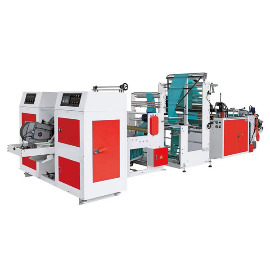
Plastic Bag Making Machine
Servo motor efficiency at partial loads: PMSMs maintain high efficiency (above 85%) even at 20-50% of rated torque, unlike induction motors whose efficiency drops at low loads. This is beneficial because bag making machines often run at variable speeds (e.g., during setup or slow production). The drive also optimizes the motor's flux to reduce iron losses at low speeds. The total power consumption of a servo machine includes the drives' losses (2-3%), motor losses (5-8%), and mechanical losses (bearings, friction – 5-10%). The regenerative system reduces the net power drawn from the mains by returning energy.
Energy monitoring: Many servo drives have built-in power meters that measure active power, reactive power, and energy consumption. These values can be logged and displayed on the HMI. Operators can monitor energy per thousand bags and identify if a particular axis is consuming more than normal, indicating inefficiency (e.g., high friction due to misalignment). The energy data can be integrated with the plant's energy management system. Some machines use an algorithm that optimizes the acceleration and deceleration profiles to minimize energy consumption while maintaining cycle time – this is called energy-aware motion planning. For example, a slightly longer acceleration (lower jerk) reduces peak torque and current, lowering losses, but increases cycle time slightly. The optimum trade-off is found by an optimizer.
Power supply sizing: The regenerative energy can cause the DC bus voltage to rise, requiring the input rectifier to have a regenerative capability (active front end) or a braking resistor. An active front end can feed the regenerative energy back to the mains, achieving near-unity power factor and reducing harmonic distortion. This is more expensive but can yield additional energy savings of 5-10%. For most machines, a braking resistor is sufficient. The resistor must be sized to handle the peak regenerative power; its resistance is chosen to limit bus voltage to a safe level (e.g., 400V for a 380V system). The resistor often has a thermal switch to prevent overheating.
By leveraging servo motor efficiency and regenerative braking, bag making machine manufacturers can significantly reduce energy costs and carbon footprint. Additionally, the reduced heat dissipation lowers cooling requirements in the factory, further saving energy. The combination of high efficiency, energy recovery, and smart motion planning makes
servo motor bag making machines a sustainable and cost-effective choice for modern production.