Servo Motor Bag Making Machine Technical Deep Dive: Servo Control Tuning and Optimization
Servo motor bag making machines rely on precise closed-loop control of each axis – film pull, sealing bar, cutting blade, punch, and stacker. The servo drive uses a cascaded control structure: an outer position loop, a middle velocity loop, and an inner current (torque) loop. The gains of each loop (proportional, integral, derivative) must be tuned to achieve fast response without overshoot or oscillation. The position loop gain (Kp) determines the stiffness – higher Kp reduces following error but can cause overshoot. The velocity loop gain (Kv) and integral gain (Ki) affect speed accuracy and disturbance rejection. The current loop is usually tuned by the drive manufacturer and not adjusted by the user. The overall bandwidth of the servo system – the frequency at which the system can respond to commands – is typically 50-200 Hz for bag making machines. For a film pull axis that must stop within 1 ms with 0.01 mm accuracy, a high bandwidth (100+ Hz) is necessary. The tuning is performed using a step response test: the axis is commanded to move a small distance, and the response is measured. The gains are adjusted to achieve a critically damped response (no overshoot) or slightly underdamped (5-10% overshoot) for faster settling. Auto-tuning features in modern drives can automatically set gains based on the measured inertia and friction, but manual fine-tuning is often needed.
Feed-forward control significantly improves performance. The velocity feed-forward term adds a command proportional to the desired velocity, reducing the phase lag of the velocity loop. The acceleration feed-forward adds a command proportional to the desired acceleration, compensating for inertia. Together, they reduce the following error by 50-80%. The feed-forward gains are set based on the axis's mechanical parameters (mass, friction). For the sealing bar axis, which has a high inertia and requires a complex motion profile, acceleration feed-forward is essential to prevent the bar from lagging behind the commanded position, which would cause mis-timed sealing. The motion profile for each axis is generated using a jerk-limited S-curve – the acceleration starts at zero, increases linearly (jerk constant), reaches maximum, then decreases to zero. This produces smooth motion with minimal vibration. The profile parameters (maximum speed, acceleration, jerk) are set to respect the machine's mechanical limits (motor torque, coupling strength) and to minimize cycle time.
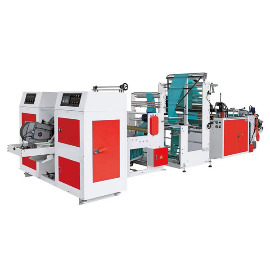
Plastic Bag Making Machine
Encoder feedback resolution and update rate are critical. Most servos use absolute encoders with 20-24 bits resolution, giving a position resolution of 0.001-0.0001 mm. The update rate for the position loop is typically 1-4 kHz, meaning the position is corrected every 0.25-1 ms. For high-speed machines, a higher update rate reduces following error. The encoder's noise level can affect stability; shielded cables and proper grounding are essential. Some drives use dual encoders – one on the motor and one on the load – to compensate for backlash and mechanical compliance. This is common in the sealing bar axis to ensure accurate contact position.
Tuning for specific motions: The film pull axis requires a fast acceleration to reach the pull speed, then a rapid deceleration to stop for sealing. The profile is asymmetrical – acceleration is limited by film tension (to avoid stretching), deceleration by the motor's braking capability. The gains are tuned to minimize settling time at the stop position. The sealing bar axis has a more symmetric profile: it accelerates down, dwells, and accelerates back. The dwell time is set by the sealing requirement; the acceleration and deceleration are tuned to reduce impact force on the film. The cutter axis (rotary) has a continuous sinusoidal profile; its tuning focuses on speed regulation and phase synchronization with the film pull.
Condition monitoring of servos: The drive records torque, current, and position error. An increase in average torque over time indicates increased friction (bearing wear). An increase in following error during acceleration may indicate insufficient feed-forward or a mechanical problem (loose coupling). The system can alert when these parameters exceed thresholds. By carefully tuning servo control loops and continuously monitoring performance,
servo motor bag making machines achieve high-speed precision, producing consistent bag quality with minimal scrap.