Square Bottom Bag Making Machine Technical Deep Dive: Multi-Panel Folding and Flap Sealing
Square bottom bags (also called block-bottom or flat-bottom bags) are characterized by a flat, rectangular base that allows the bag to stand upright and stack neatly. The bottom is formed by a series of folds that create overlapping flaps, which are then glued or heat-sealed together. The folding sequence is complex: the film is creased along multiple lines, and the bottom flaps are folded inward, often with a tucking motion. The folding station consists of a series of folding plates, tucking blades, and creasing rollers. The film is first creased to define the bottom panel, then the side panels are folded, and finally the bottom flaps are tucked and glued. The crease pattern must be precise; a misalignment of 1 mm can cause the bottom to be asymmetrical or not lie flat. The folding station is often servo-driven and adjustable for different bottom sizes. The creasing rollers are heated to set the creases, and the pressure is controlled to avoid film damage. The folding plates are made of polished metal with low-friction coatings.
After folding, the flaps are secured by adhesive or heat sealing. Hot melt adhesive is commonly used, applied by a nozzle or a roller. The adhesive must be applied in the correct amount – too much causes oozing, too little causes weak bonding. The adhesive temperature and viscosity are controlled by a thermostatically heated system. The flaps are then pressed together by a press station, which applies pressure (2-5 bar) and heat (if using heat sealing) for a defined dwell time (0.5-1.5 seconds). The press station may have a contoured platen that matches the bottom shape, ensuring even pressure. After pressing, the bottom is cooled to set the adhesive or seal. The cooling is often by air or a chill plate. The bottom-forming process adds significant time to the bag cycle; therefore, square bottom machines are slower (20-60 BPM) compared to simpler bag makers. To compensate, some machines use a rotary turret design with multiple forming stations operating in parallel.
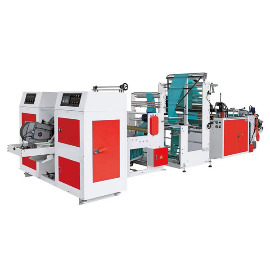
Plastic Bag Making Machine
Folding geometry: The bottom dimensions (width and depth) determine the fold pattern. The most common design is the "block bottom" with four flaps: two side flaps and two end flaps. The fold angles are typically 45 degrees. The crease lines must be precisely positioned relative to the bag's side seals. The film tension through the folding station must be low to allow easy bending; a dancer or a loop accumulator provides the necessary slack. The folding plates are adjustable for different bottom sizes; changeover can be time-consuming, so quick-change systems are used.
Sealing/adhesive application: For heat sealing, the flaps must be made of a heat-sealable material (e.g., PE coating). The sealing temperature is higher than for standard seals because of the multiple layers. The pressure must be uniform across the bottom; any unevenness causes weak spots. For adhesive, the adhesive is applied just before the folding, and the press station applies pressure without heat. The adhesive curing time may limit speed; hot melt adhesive cures quickly, making it preferred for high-speed machines.
Quality control: The bottom flatness is checked by placing the bag on a flat surface; any bulge or asymmetry is a defect. The bottom seal/adhesive strength is tested by peel and burst tests. The machine's vision system can inspect the bottom shape and flap alignment. The adhesive weight is monitored by a flow meter; a deviation triggers an alarm.
Maintenance: The folding plates and tucking blades must be kept clean and free of scratches. The adhesive applicator needs regular cleaning to prevent clogging. The press station's heating elements and thermocouples require calibration. By mastering multi-panel folding and flap sealing,
square bottom bag making machines produce sturdy, stable bags that are preferred for coffee, pet food, and other premium products requiring a robust, space-efficient packaging solution.