T-Shirt Bag Making Machine Technical Deep Dive: Notching and Easy Tear Design
In addition to handle holes, T-shirt bags feature a center notch at the top edge that facilitates tearing off individual bags from a roll or a stack. The notch acts as a stress concentrator, guiding the tear to start precisely at the intended point. The notch geometry – typically a V-shape, U-shape, or a straight cut – determines the tearing force and the reliability of the tear. The notch is created by the same punching mechanism that cuts the handles, often in a single stroke. The notch depth and angle are critical: too deep or sharp may cause premature tearing during handling; too shallow may make it difficult to tear. The optimum V-notch angle is 30-60 degrees, with a depth of 2-5 mm. The notch edges must be clean and free of micro-tears to ensure consistent tear initiation. The tear strength of the film (in the machine direction) and the notch geometry together determine the tearing force, which is typically 1-5 N for LDPE. The tear propagation is influenced by the film's orientation; biaxially oriented films tear more easily in the machine direction. The notch is often combined with a perforation line across the bag to facilitate tearing into individual bags. The perforation consists of a series of small holes (punched or cut) with a specified pitch and remaining material width. The perforation strength is adjusted so that the bag tears easily but does not open during transport.
The notching and perforation unit is integrated with the punching mechanism or as a separate module. In high-speed machines, the perforation is made by a rotating blade with teeth (like a serrated wheel) that presses against a backing roll. The tooth depth and spacing determine the perforation pattern. The pressure must be precisely controlled; too high causes the film to tear prematurely, too low leaves the bags connected. The notch and perforation must be registered with the print and handles; any misalignment causes functional defects. The registration system for the notch is often the same as for the handles, using the same print mark.
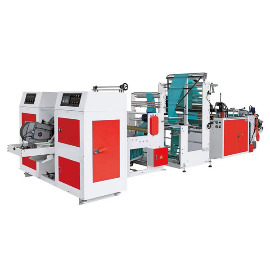
Plastic Bag Making Machine
Mechanical design for easy tear: The notch creates a stress concentration factor (Kt) that depends on the notch radius. A sharp V-notch has a higher Kt, making it easier to tear but more prone to accidental tearing. A U-notch has a lower Kt, providing a balance. The machine's punch can be designed with interchangeable inserts for different notch geometries, allowing flexibility. The tear direction is also influenced by the film's molecular orientation; the punch should align with the machine direction (MD) for optimal tear. Some machines include a pre-cutting station that slightly scores the film along the tear line to guide the tear, reducing the notch depth required. This is particularly useful for thicker films.
Quality control: The tearing force is measured using a tension tester on sample bags. The acceptable range is specified (e.g., 2-4 N). If the force is too high, the notch is deepened or the perforation is increased. If too low, the notch is reduced. The machine can have an automated system that measures the tearing force by pulling a bag from a roll and records the peak force; if it deviates, the machine adjusts the perforation depth or notch geometry. This is a closed-loop quality control system.
Dispensing performance: The notch and perforation must work together for reliable dispensing from a roll or a box. The bags should tear off cleanly without leaving remnants or causing the next bag to tear. The notch design is often tested in customer usage conditions; feedback is used to refine the geometry. For example, a "butterfly" notch – a V-notch with a small slit on each side – has been found to provide the best balance of tear ease and stability. The machine's ability to produce consistent notches at high speed is essential for the bag's functionality. By optimizing the notch and perforation design,
T-shirt bag making machines produce bags that are convenient for retailers and consumers, enhancing the user experience and reducing waste from torn or untearable bags.