T-Shirt Bag Making Machine Technical Deep Dive: Punching Mechanism Design and Optimization
The punching mechanism is the defining feature of a T-shirt bag making machine, creating the handle holes and the center notch that allow bags to be easily carried and dispensed. The punching unit typically consists of a punch die (male) and a matching die plate (female) or anvil. The punch is driven by a pneumatic cylinder, servo motor, or cam mechanism to cut through the film. The punch geometry must be sharp and precisely aligned to produce clean holes without residual film "hair" or tearing. The punch shape is usually elliptical or keyhole-shaped, with the center notch being a V-cut or a straight cut. The cutting force required is a function of the film's shear strength, thickness, and the total cutting perimeter. For 50-micron LDPE with a shear strength of 10 MPa, and a punch perimeter of 200 mm, the force is approximately: Force = Shear Strength × Perimeter × Thickness = 10e6 × 0.2 × 0.00005 = 100 N. However, due to friction and the need for a clean cut, the actual force is typically 2-3 times higher. The punch must be made of tool steel (e.g., D2 or O1) or tungsten carbide, hardened to HRC 58-62. The punch edge must be maintained with a sharp angle (20-30 degrees) and regular sharpening.
The punch mechanism operates in synchronization with the film advance. In intermittent machines, the film is stopped during punching. The punching cycle time must be short to not limit overall speed. For a 150 BPM T-shirt machine, the cycle time is 400 ms; the punching dwell might be 50-100 ms. This requires high-speed actuation. Servo-driven punches can achieve faster cycle times because they can control acceleration and deceleration precisely, reducing impact noise and wear. The punch depth is critical: it must cut fully through the film but not damage the backing plate. The gap between punch and die is typically 0.02-0.05 mm. The die plate is often made of hardened steel or a composite material with a sacrificial surface that can be replaced. The punch unit also includes a scrap removal system: a suction or blow-off mechanism that removes the cut-out film pieces (scrap) to prevent them from interfering with the process.
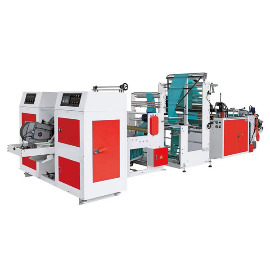
Plastic Bag Making Machine
Wear and maintenance: The punch edge dulls over time, causing ragged cuts and increased force. The service life is typically 1-5 million cycles, depending on film abrasiveness (filled films cause faster wear). The punch can be resharpened, but after 5-10 sharpenings, it must be replaced. The die plate also wears; its slot may widen, reducing cutting quality. The punch alignment must be checked regularly; misalignment causes uneven cutting and increased wear. Some machines use a floating punch head that self-aligns to reduce side loads. The punch actuator's bearings and seals require periodic lubrication. The scrap removal system must be kept clear; a blockage causes scrap to be carried into the sealing area, causing defects.
Optimization techniques: For high-speed punching, a rotary die cutter can be used, where the punch is mounted on a rotating cylinder, and the film passes between the cylinder and an anvil roller. This allows continuous punching without stopping the film, increasing speed. Rotary dies are more expensive but offer longer life and higher speeds (up to 250 BPM). The die pattern can be customized for different handle shapes. Another optimization is using a heated punch – heating the punch slightly (50-80°C) reduces the cutting force by softening the film, but it requires temperature control to avoid melting. Some machines use a laser cutting system for handles, which is contactless and eliminates wear, but is slower and more expensive. The choice depends on speed and cost requirements.
Quality control: The handle cut quality is inspected visually or by a camera system. Defects include incomplete cuts, burrs, or tears. If defects are detected, the machine can adjust the punch depth or pressure automatically. The scrap weight is also monitored; a sudden change indicates punch wear or misalignment. By optimizing the punching mechanism,
T-shirt bag making machines achieve high-speed, consistent handle cutting, ensuring that the bags meet retail standards for strength and appearance, while minimizing maintenance and downtime.