T-shirt bag making machine
A T-shirt bag making machine is a specialized bag production system designed to manufacture plastic bags with integral handle cut-outs, resembling a T-shirt shape when laid flat. These bags are ubiquitous in retail, supermarkets, and convenience stores as shopping carriers. The machine produces bags from a single roll of film (typically HDPE, LDPE, or biodegradable blends), forming bottom seals, cutting the top edge, and punching handle holes and a central notch – all in a continuous high-speed process. T-shirt bag making machines are among the most widely purchased bag making equipment due to the massive global demand for retail shopping bags. They are available in semi-automatic and fully automatic configurations, with production speeds ranging from 100 to over 200 bags per minute, depending on the machine's size and automation level.
The operational sequence of a T-shirt bag making machine begins with film unwind and tension control, followed by a series of forming and sealing stations. The film passes over a folding board that may create a gusset (optional) for extra capacity, though standard T-shirt bags are usually not gusseted. The film then moves to the bottom sealing station, where heated bars seal the bottom edge of each bag. Next, the film advances to the cutting and punching section – this is the distinctive feature of a T-shirt bag machine. A rotary or flat-bed die punch simultaneously cuts the top edge to create the handle opening and a central notch that allows easy tearing and dispensing. The punched film then moves to a final cutting knife that separates individual bags. The finished bags are stacked on a conveyor, counted, and transferred to a packing table. Modern machines incorporate a registration camera to ensure the punch aligns correctly with any pre-printed graphics on the film.
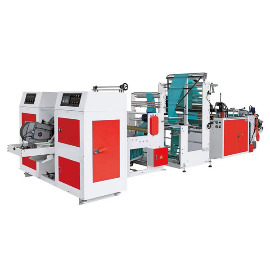
Plastic Bag Making Machine
Key technical specifications for T-shirt bag making machines include bag width (typically 200-600 mm), bag length (300-800 mm), film thickness (15-60 microns for LDPE/HDPE), and production speed (120-200 BPM for standard models, up to 250 BPM for high-speed servo machines). The punch unit is rated by its force and frequency, with heavier-duty punches handling thicker films. Sealing temperature is adjustable between 120-200°C, with separate zones for bottom seal and handle sealing (if a handle seal is used). The machine requires compressed air (6-8 bar) for pneumatic actuators, and electrical power of 15-30 kW depending on heater and servo motor sizes. The stacking unit typically holds 50-200 bags per stack, with an automatic counter and discharge system. Optional features include an automatic splicer for non-stop operation, a printing unit for in-line branding, and an in-line bag opener for easier dispensing in stores.
Applications of
T-shirt bag making machines are predominantly in the retail sector. Supermarkets and hypermarkets rely on these machines to produce millions of shopping bags annually, often printed with store logos and promotional messages. Boutiques, clothing stores, and convenience stores also use T-shirt bags for customer purchases. They are also used for promotional events and trade shows as giveaway bags. In some regions, T-shirt bags are reused as waste bin liners, extending their utility. With the growing focus on sustainability, many T-shirt bag making machines are now adapted to process biodegradable and compostable films (PLA, PBAT), as well as recycled PE content. This adaptation requires modifications to sealing temperature and punch pressure, as biopolymers are more heat-sensitive. The machine's versatility makes it a valuable asset for converters serving the retail packaging market.
Selecting a T-shirt bag making machine involves evaluating output requirements, film types, and available floor space. Determine your daily production target – for a medium-sized converter, a machine with 150 BPM and 8-hour shifts produces approximately 72,000 bags per day, sufficient for many regional suppliers. Choose between a standard model with mechanical clutch and a servo-driven model; servo offers higher speed, better accuracy, and lower energy consumption (30% savings) but costs 20-30% more. Consider the punch unit's durability – tungsten carbide punches last longer than steel ones, reducing replacement costs. If you need printed bags, an in-line flexo printer can be integrated, but ensure the registration system is capable of the machine's maximum speed. Also, check the stacker's capacity and ease of unloading; a stacker with a conveyor belt reduces manual labor. Finally, verify the machine's CE certification if exporting to Europe, and confirm that the supplier provides spare parts for the punch unit, as it experiences high wear.
Maintenance of a T-shirt bag making machine focuses on the punch unit and sealing bars. The punch dies require daily cleaning to remove film residue and periodic sharpening (every 1-2 million cycles) to maintain clean handle cuts. Lubricate the punch mechanism with high-temperature grease weekly. Sealing bars should be cleaned with a brass brush every shift to prevent carbon buildup that creates uneven seals. Inspect the heating elements and thermocouples monthly for accurate temperature control. The film guide rollers must be aligned to prevent wrinkling that can cause mis-punching. The stacking conveyor belts should be checked for tension and wear. For servo-driven machines, check encoder cables and motor couplings quarterly. Keep a log of punch die life and seal quality to schedule preventive replacements. By adhering to a disciplined maintenance schedule, a T-shirt bag making machine can deliver consistent, high-quality bags and maintain high uptime, ensuring a reliable supply to retail customers.