Three-Side Sealing Bag Making Machine Technical Deep Dive: Multi-Station Sealing Synchronization
Three-side sealing bag making machines produce pouches with seals on the left, right, and bottom edges. This requires three separate sealing stations (or a single three-sided jaw) that must be precisely synchronized. In the most common configuration, the film is folded in half (forming the bottom fold), and then two side seals are applied. The side seals are typically made by a pair of vertical sealing bars, while the bottom seal (the fold) is not sealed separately – it is the fold. However, some machines also apply a bottom seal to reinforce the fold. The sealing stations can be arranged sequentially or simultaneously. In a simultaneous design, a single jaw with three sealing bars (shaped like an inverted U) contacts the film in one stroke, sealing all three sides at once. This requires a very precise alignment of the three bars to ensure uniform pressure and temperature. The jaw is often servo-driven with a cam profile that ensures the bars contact the film at the exact same time. The sealing dwell time is typically 0.2-0.5 seconds, and the temperature is controlled independently for each bar to accommodate different film thicknesses at the edges and bottom.
In a sequential design, the film moves through the machine, first receiving the bottom seal (if any), then the side seals, and finally cutting. The synchronization of these stations is critical – the distance between the stations must match the pitch of the pouches. The film feed is intermittent; after each cycle, the film advances by the pouch length. The sealing stations are triggered by the same encoder signal to ensure that the seals are applied at the correct positions. The registration system (print mark detection) adjusts the film feed to align the seals with the print. For high-speed machines (above 150 BPM), the film feed must be very fast, and the sealing stations must operate within the stop period. The side sealing bars are often lightweight and pneumatically actuated for fast response. The bottom seal bar may be wider to accommodate the fold. The cutting station (rotary or guillotine) is positioned after the sealing stations and is also synchronized. The control system uses a virtual master axis to coordinate the film pull, sealing, and cutting axes. Each axis follows an electronic cam profile relative to the master. The phase offsets between axes are adjustable via the HMI to fine-tune timing.
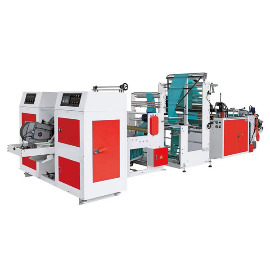
Plastic Bag Making Machine
Pressure and temperature profiles: For three-side seals, the pressure must be uniform across each seal. The bars are designed with a slightly convex surface to compensate for film thickness variations. The temperature of each bar is controlled by a separate PID loop, and the setpoints may differ – e.g., the bottom seal may require a higher temperature due to the folded double layer. The control system can store recipes with different temperature and pressure settings for each seal. During production, the machine monitors the seal quality (via vision) and can adjust the dwell time or temperature for individual bars.
Challenges in three-side sealing: The film tension must be carefully managed because the film is folded and sealed; any tension variation causes misalignment of the fold and the side seals. The folding station (which creates the bottom fold) must be precisely adjusted for each film thickness. The side seals must be perfectly perpendicular to the bottom seal to produce a rectangular pouch. Any skew causes the pouch to be misshapen. To correct skew, the machine may have a separate alignment roller that adjusts the film angle before sealing. The machine's control system can also adjust the phase of one side seal relative to the other to compensate for film drift.
Maintenance: The three sealing bars require regular cleaning and flatness checks. The temperature sensors and heaters for each bar need calibration. The folding station must be kept clean and free of residue. By optimizing multi-station sealing synchronization,
three-side sealing bag making machines produce high-quality pouches with consistent, strong seals, essential for snack, condiment, and pharmaceutical packaging.