Vest Bag Making Machine Technical Deep Dive: Die-Cutting and Gusset Formation
Vest bag making machines are distinguished by their ability to produce bags with die-cut handles that are stronger and more comfortable than the punched handles of T-shirt bags. The die-cutting process uses a steel rule die (a flat or rotary die) that cuts the handle shape, typically a U- or oval-shaped opening, in one stroke. The die consists of sharp steel blades mounted on a base, which cut through the film layers. The cutting force is significantly higher than for punching because the die cuts a larger perimeter and often includes internal cut-outs for the handle. For a typical vest bag, the handle cut-out is about 200-300 mm long, requiring a force of 500-1000 N for 50-micron film. The die must be precisely aligned to the print and the gusset. The die-cutting station is often a separate module with a heavy-duty press mechanism, either pneumatic or hydraulic, to provide the necessary force. The die is made of tool steel with a hardness of HRC 56-60, and the cutting edge is beveled at 20-25 degrees. The die also includes creasing rules to create a fold line for the handle reinforcement (if applicable). The die has a counter-plate (anvil) made of nylon or fiber-reinforced plastic that cushions the cut and prolongs die life.
Gusset formation is another key feature. The gusset is created by folding the film edges inward to form side pleats, increasing the bag's expansion capacity. The folding is done by a series of folding plates (forming boards) that progressively fold the film as it moves. The gusset depth is adjustable, typically 20-100 mm. The folding plates are precision-machined and often coated with a low-friction material. The film tension must be precisely controlled during gusseting to avoid wrinkles. The gusset is then sealed at the bottom and sometimes tacked at the top. The gusset former is placed before the sealing and die-cutting stations. The gusset depth must be consistent; any variation causes asymmetrical bags. The gusset folding also affects the handle cut – the die must cut through the multiple layers of the folded gusset, requiring higher force and more durable dies.
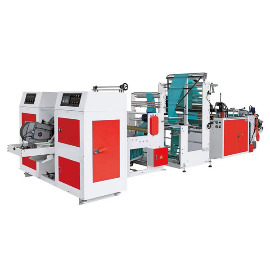
Plastic Bag Making Machine
Integration of die-cutting and gusseting: The two processes must be synchronized. The gusset folds must be formed exactly at the correct position relative to the handle cut. This is achieved by precise registration using print marks. The machine's control system adjusts the film feed and the die position (in servo-driven dies) to maintain alignment. The die-cutting station often has a registration camera that detects the handle position and corrects any drift. The die can be indexed (rotated) to accommodate different handle angles or bag sizes. The changeover for different vest bag designs involves replacing the die and adjusting the gusset formers, which can be time-consuming; quick-change systems reduce this to under 5 minutes.
Handle reinforcement: Some vest bags have an additional seal or tape around the handle cut to reinforce it and prevent tearing. This reinforcement is applied by a separate station that may use ultrasonic or heat sealing to attach a strip of film. The reinforcement adds strength but increases complexity. The machine's control must coordinate the reinforcement application with the die-cutting. The reinforcement material is fed from a separate roll and cut to length.
Maintenance of die-cutting: The die blades wear and must be sharpened or replaced. The life is typically 1-3 million cuts. The anvil (counter-plate) also wears and requires periodic rotation or replacement. The die must be kept clean to prevent film residue buildup, which causes poor cuts. The die's alignment with the film path is critical; misalignment causes off-center handles and bag rejects. Regular inspection with a die-checking station is recommended. By mastering die-cutting and gusset formation,
vest bag making machines produce high-quality, durable bags that are preferred for heavier retail items, providing strength and convenience for both consumers and retailers.