Vest Bag Making Machine Technical Deep Dive: Servo Synchronization for Complex Multi-Station Operations
Vest bag making machines are complex multi-station systems that must coordinate film feed, gusset folding, side sealing, bottom sealing, die-cutting of handles, and reinforcement (if any). Each station has its own motion requirements. The film feed is intermittent or continuous; gusset folding is continuous; die-cutting is intermittent; sealing is cyclic. To achieve high-speed operation (e.g., 120 BPM), all stations must be synchronized precisely. This is accomplished by using a virtual master axis (time base) generated by the motion controller. Each station's servo axis follows an electronic cam profile relative to the master. The master can be the film pull servo, which provides the reference for all other axes. The film pull advances the film, then pauses for sealing and die-cutting. During the pause, the die-cutting and sealing occur. The gusset forming rollers run continuously, but the film tension in that section is controlled by a dancer that buffers the intermittent advance. The synchronization accuracy required is typically ±1 mm for mechanical positions and ±0.5° for phase angles.
The die-cutting station is the most demanding in terms of synchronization. The die must come down and cut exactly when the film is stopped and positioned correctly. The die's vertical motion is servo-driven, with a profile that includes a rapid descent, a brief dwell (for cutting), and rapid ascent. The descent timing must match the film's stop interval. If the film is pulled by a servo with a position loop, the stop position may have a settling error; the die's controller can use the film's actual position feedback to adjust its timing (a technique called "flying" registration). This reduces the need for precise mechanical stops. The die's pressure profile is also controlled; the pressure can be varied during the dwell to achieve a clean cut.
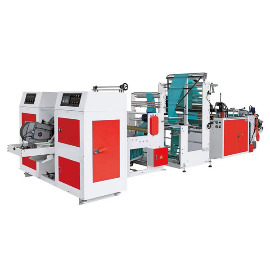
Plastic Bag Making Machine
Gusset folding synchronization: The gusset formers are passive but the film tension in that section must be kept constant. The pull rollers before the gusset former are driven by a servo that follows the same master, but with a slight phase shift to maintain the buffer (dancer) position. The dancer position is used as a feedback to adjust the phase shift. The gusset fold depth is set by the physical position of the folding plates; however, the fold position along the film is determined by the film advance. If the film advance varies, the fold position shifts. Therefore, the registration for the fold is often linked to the same print mark as the handle cut, ensuring that the gusset is always aligned with the handle.
Sealing synchronization: The bottom and side sealing bars must close and seal at the correct time. They are often actuated by servo motors or cam mechanisms. Their motion profiles are timed to occur during the film stop. The sealing dwell time must be long enough for the film, but it reduces the available time for die-cutting and other operations. Therefore, the controller must balance the timing of all stations to achieve the desired cycle time. For high-speed machines, the dwell times are minimized, and overlapping operations are used – e.g., the film can start advancing before the die has fully retracted, if there is sufficient clearance (this is called "early start").
Troubleshooting synchronization issues: If the die-cut is misaligned with the gusset or print, the registration system is checked. The phase offset is adjusted. If the film tension fluctuates, the dancer control is tuned. If the die-cutting pressure is inconsistent, the servo's torque limit is checked. The machine's control system logs the motion profiles and errors for each axis, allowing diagnosis. Advanced machines use an integrated simulation tool that can visualize the motion of all axes and identify timing bottlenecks. By achieving precise servo synchronization,
vest bag making machines operate reliably at high speeds, producing consistent, high-quality vest bags with minimal rejects.