Woven Bag Making Machine Technical Deep Dive: Hot Air Sealing for Coated PP Fabric
Woven bag making machines for PP fabric often use hot air sealing to bond the coated layers. The woven fabric is coated with a thin layer of PE or PP copolymer (20-40 g/m²), which melts under heat and fuses the layers. The hot air sealing system consists of a hot air blower, a nozzle, and a pair of pressure rollers. The hot air (200-300°C) is directed onto the coating as the fabric passes; the heat melts the coating, and the pressure rollers press the fabric layers together, forming a bond. The nozzle design is critical: it must provide uniform temperature across the seal width (typically 300-800 mm) and a consistent air flow. The nozzle gap and the distance to the fabric affect the heat transfer efficiency. Computational fluid dynamics (CFD) is used to design nozzles that minimize temperature variation across the width. The hot air temperature is controlled by a PID loop with a thermocouple placed near the nozzle outlet. The temperature accuracy is ±5°C. The fabric speed affects the dwell time; the machine's control system adjusts the hot air temperature based on the speed – higher speed requires higher temperature. The pressure rollers are rubber-coated or steel, with a nip pressure of 4-8 bar. The rollers may be heated (50-80°C) to assist in bonding. The seal strength is measured by peel test; the failure should be in the fabric, not the seal.
Coating weight and quality: The coating weight must be uniform; variations cause weak seals. The machine can include a coating thickness gauge (beta or IR) that measures the coating weight online. If the coating is too thin, the machine increases the hot air temperature or pressure to compensate, but this is limited. The fabric's moisture content affects sealing; high moisture absorbs heat, reducing seal strength. The machine may have a pre-heating station to dry the fabric before sealing. The hot air system also includes an exhaust to remove fumes and moisture. The hot air blower is often gas-fired or electric; gas is more cost-effective for large lines.
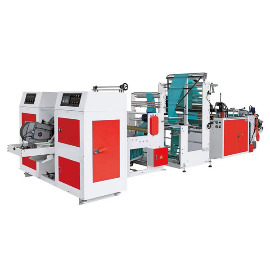
Plastic Bag Making Machine
Seal integrity testing: The seal is tested by a peel tester and a drop test (sacks filled with test material and dropped from 1-2 meters). The machine can include an in-line seal strength monitor that measures the peel force on a sample. The data is used for SPC. If the seal strength drops, the operator can adjust the temperature or pressure. The machine's control system logs the seal strength and correlates it with the production parameters.
Alternative sealing methods: Some woven bags use impulse sealing (for thicker coatings) or ultrasonic sealing (for uncoated fabrics with tie layers). Hot air is the most common for high-speed lines. The machine can be retrofitted with different sealing systems for different materials. The hot air system requires a clean air supply; filters must be replaced regularly.
Maintenance: The hot air nozzle must be cleaned of any coating residue; a clogged nozzle causes uneven heating. The pressure rollers need periodic inspection for wear and flatness. The hot air blower's bearings and motor require lubrication. The temperature sensors need calibration. By optimizing hot air sealing,
woven bag making machines produce strong, reliable seals on PP sacks, essential for heavy-duty packaging in agriculture and construction.