automatic bag making machine
An automatic bag making machine represents the pinnacle of bag production technology, performing the entire bag forming, sealing, cutting, stacking, and often packing process with minimal human intervention. These machines are equipped with PLC controllers, touchscreen interfaces, and servo-driven axes that synchronize all movements, ensuring consistent output regardless of operator skill. Automatic bag making machines are indispensable in modern manufacturing environments where labor costs are high, quality standards are stringent, and production volumes demand round-the-clock operation. They are used across all bag types – from simple flat bags to complex zipper and stand-up pouches – and are available in configurations for both film-based and nonwoven materials, offering versatility and reliability that manual or semi-automatic machines cannot match.
The operational workflow of an automatic bag making machine is orchestrated by a central control system that coordinates film feeding, sealing, cutting, and stacking in a seamless sequence. The machine starts with an unwind stand that automatically adjusts tension via a servo-driven dancer roller, maintaining consistent film feed even as the roll diameter changes. The film then passes through a printing registration unit with a high-speed photoelectric sensor that detects registration marks and adjusts the film feed on-the-fly to ensure accurate cutting and sealing. Sealing is performed by pneumatically or servomotor-actuated jaws that close with precise force and dwell time, with temperature controlled by PID controllers. Cutting is done by a rotary knife or guillotine blade, also servo-controlled to match the bag length. Finished bags are delivered to a stacking unit that counts, aligns, and compresses them into bundles, which are then automatically conveyed to a packing station. Throughout this process, the machine continuously monitors its own performance, generating alarms or stopping automatically if any deviation is detected, such as film breakage, temperature drift, or jam.
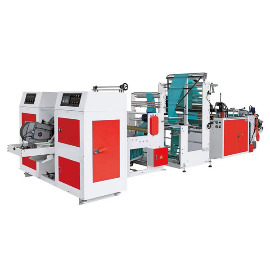
Plastic Bag Making Machine
Key technical features of automatic bag making machines include high-level automation, fault diagnostics, and recipe management. Automation levels range from semi-automatic (requiring manual film threading and start-up) to fully automatic with auto-splicing that changes rolls without stopping. Advanced models feature a central HMI with a large color touchscreen displaying real-time production data, such as speed, count, waste percentage, and downtime reasons. Recipe management allows storing hundreds of bag specifications (length, width, seal temperature, punch settings) for instant recall, reducing changeover time to under five minutes. Diagnostic systems perform self-checks on sensors, heaters, and actuators, and display error codes with troubleshooting guides. Connectivity options include Ethernet, Profibus, and OPC-UA, enabling integration with factory MES systems for remote monitoring and production planning. Safety features such as light curtains, emergency stop circuits, and two-hand controls are standard, ensuring operator protection while maintaining high productivity.
Different levels of automatic bag making machines are available to suit various production scales and budgets. The entry-level automatic machine is a table-top unit with basic PLC control, suitable for small manufacturers producing 10-30 bags per minute with limited automation. The mid-range automatic machine includes servo drives for main movements, automatic tension control, and a stacking conveyor, achieving 80-150 bags per minute, ideal for medium-sized converters. The high-end automatic machine features all-servo axes, auto-splicing, in-line leak detection, and a fully automated packing module, capable of 200-300 bags per minute with minimal operator attendance. There are also dedicated automatic machines for specific bag types: the automatic T-shirt bag machine includes a servo punching unit for handles; the automatic zipper bag machine has an integrated zipper applicator; and the automatic heavy-duty sack machine uses reinforced sealing bars and a high-capacity stacking table. Each machine is built with robust construction to withstand continuous operation, with rated duty cycles of 24/7 for high-end models.
Applications of
automatic bag making machines cover all major bag-producing sectors, with the primary benefit being labor cost reduction. In large retail bag plants, a single automatic machine can replace up to four semi-automatic machines, producing the same output with only one operator instead of four, and with higher consistency. Food packaging converters use automatic machines to produce pouches for snacks, frozen foods, and liquids, where the precision of sealing and cutting directly impacts shelf life and customer perception. Medical device manufacturers rely on automatic bag making machines for sterile packaging, where validated process control and traceability are mandatory, and the automation ensures each bag meets strict quality standards. Industrial sack producers use automatic heavy-duty machines to make cement and feed sacks, where the high output and consistent seal strength reduce material waste and rework. Even small custom packaging shops are adopting compact automatic machines to compete with larger manufacturers, as the reduced labor requirement allows them to offer competitive pricing while maintaining quality.
Selecting an automatic bag making machine involves analyzing production requirements, film materials, and the desired level of automation. Start by defining your average and peak daily production in number of bags, and choose a machine with a rated speed at least 20% above your peak to allow for maintenance and future growth. List all bag styles and dimensions you intend to produce, as this determines the required tooling (sealing bars, punches, folding plates) and the machine's size range. Evaluate your film inventory – if you use multiple film types with different sealing properties, ensure the machine has sufficient temperature range and pressure adjustability. Decide on the automation features you need: auto-splicing for long runs, in-line printing for branded bags, or leak detection for quality-sensitive products. Consider the physical space and power supply, as larger automatic machines require substantial floor area and three-phase power. Budget for installation, operator training, and initial spare parts; many suppliers offer turnkey packages that include these services. Also, request references from existing customers and visit their facilities to see the machine in operation, as this provides real-world insights into reliability and after-sales support.
Maintenance of an automatic bag making machine is systematic and data-driven, thanks to the machine's built-in diagnostics. The control system tracks run hours, cycle counts, and temperature cycles for each component, generating alerts when maintenance is due. Daily tasks remain simple: clean sealing bars, check film path for debris, and inspect safety devices. Weekly, lubricate all servo motor couplings, check air filters, and test emergency stops. Monthly, calibrate temperature sensors and pressure transducers using external reference devices, and inspect the cutter blades for wear. Use the machine's self-diagnostic feature to run a full test sequence each month, verifying that all axes move correctly and sensors respond properly. Keep a digital log of all maintenance activities, alarms, and repairs, which helps in identifying recurring issues and planning preventive replacements. Train at least two operators and one maintenance technician on the machine's controls and troubleshooting procedures, so that minor problems can be resolved quickly without waiting for external service. By leveraging the automation and diagnostic capabilities, a well-maintained automatic bag making machine can achieve uptime exceeding 95%, delivering consistent high-quality output with minimal manual intervention over its operational life.