bag making machine automation
Automation in bag making machines has evolved from simple relay logic to sophisticated computer-controlled systems that integrate PLCs, servo drives, vision systems, and IoT connectivity. Automation reduces manual intervention, improves consistency, enables remote monitoring, and provides data for predictive maintenance. This guide covers the key automation components, their functions, levels of automation, benefits, and considerations for upgrading or purchasing an automated bag making machine. It also discusses the integration with factory management systems and the role of Industry 4.0 in flexible packaging production.
Core automation components: 1) PLC (Programmable Logic Controller) – the brain of the machine, running the control logic for all sequences: film feed, sealing timing, cut timing, stacking, and safety. Modern PLCs have fast processing (under 1 ms cycle time) and support multiple communication protocols. 2) HMI (Human-Machine Interface) – touchscreen panel for operators to set parameters, view production data, and diagnose alarms. 3) Servo motors and drives – provide precise, high-speed motion control for film pull, sealing bar actuation, and cutting. Servos use encoders for closed-loop feedback, ensuring accuracy. 4) Sensors – photoelectric for registration, load cells for tension, thermocouples for temperature, proximity switches for position. 5) Vision systems – cameras for print registration and defect inspection. 6) IoT modules – for data transmission to cloud or on-premise servers.
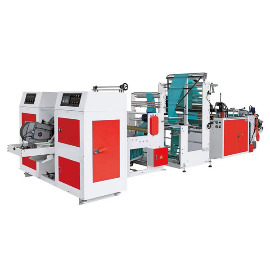
Plastic Bag Making Machine
Levels of automation: Basic automation – PLC-controlled with manual roll changes and manual stacking. Semi-automatic – includes automatic tension control and self-diagnostic alarms. Fully automatic – includes automatic roll splicing, automatic stack discharge, and in-line quality control. Advanced – includes predictive maintenance algorithms, recipe management for quick changeover, and remote access for support. The level chosen depends on production volume, labor availability, and budget. Higher automation reduces labor cost and human error but increases initial investment and complexity.
Benefits of automation: 1) Consistent quality – machine settings are precisely maintained, reducing variability. 2) Higher speed – servo drives allow faster, smoother motion. 3) Reduced waste – automatic registration and defect detection minimize rejects. 4) Labor savings – one operator can monitor multiple machines. 5) Data logging – track OEE, reject rates, and energy use for continuous improvement. 6) Quick changeover – recipe storage enables rapid size switching. 7) Remote diagnostics – technicians can troubleshoot from anywhere, reducing downtime.
Integration with MES/ERP: Automated bag making machines can connect to manufacturing execution systems to report production counts, downtime reasons, and quality data in real-time. This enables better production planning, inventory management, and traceability. For example, when an order is completed, the system can automatically notify the warehouse. For pharmaceutical or food packaging, data logging is essential for compliance.
Considerations for automation: Ensure your facility has a stable network and power supply. Invest in training for operators and maintenance staff on the automation system. Backup all software and parameters. When buying an automated machine, ask about the openness of the control system – can it integrate with your existing systems? Also, consider the cybersecurity of IoT-connected machines. Automation is a long-term investment that pays off through improved efficiency, quality, and competitiveness. By embracing automation, bag manufacturers can meet the growing demands for just-in-time delivery, customization, and sustainability.