bag making machine bag counting
Bag counting is an essential function in bag making machines to track production output, ensure accurate bundle sizes for packaging, and monitor efficiency. Counting is typically performed at the stacking or winding station, using sensors (photoelectric, proximity, or mechanical) that detect each bag as it passes. The count is displayed on the HMI and can be used to trigger automatic bundle discharge when a preset number is reached. Accurate counting is critical for meeting customer order quantities, reducing labor in manual counting, and preventing disputes over bag counts. This guide covers the various counting technologies, their advantages and limitations, how to calibrate and troubleshoot counting systems, and integration with batching and packaging equipment.
Counting methods: The most common is a photoelectric sensor mounted near the stacking conveyor or discharge chute. As each bag passes, it interrupts the light beam, generating a pulse that increments the counter. For transparent or thin films, a reflective sensor or a through-beam with high sensitivity is used to detect the bag's edge. For thicker opaque bags, a simple proximity switch may suffice. Some machines use a mechanical finger or flag that is lifted by each bag, which actuates a microswitch – this is reliable but slower and less suited for high speeds. For perforated roll bags, counting can be done by counting the perforations using a sensor that detects the tear line.
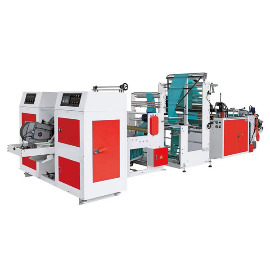
Plastic Bag Making Machine
Accuracy and reliability: Photoelectric sensors are accurate up to 0.1 ms response time, suitable for speeds over 300 BPM. However, they can be fooled by transparent films, dust, or static. To improve reliability, use a sensor with a small beam spot and adjustable sensitivity. Also, consider using a dual-sensor system that counts only when both sensors see the bag, reducing false counts from film flutter. For transparent films, a sensor that detects changes in refraction (e.g., capacitive) can be used. Regularly clean the sensor lenses to prevent dust buildup. Mechanical counters are more robust in dusty environments but need periodic calibration.
Batch counting and bundle discharge: The counter is typically linked to a batch controller. The operator sets the desired bundle size (e.g., 50 or 100 bags). When the count reaches the set number, the machine automatically triggers a discharge – either a stacker conveyor moves to drop the bundle onto a packing table, or a pusher ejects the bundle. This automation reduces manual labor and ensures consistent bundle counts. For roll winding machines, the counter controls the roll length (number of bags per roll) and signals the cut-off knife to sever the roll. Accurate batch counting is essential for downstream packing and shipping.
Integration with production data: Modern machines record total counts per shift, day, and month, displaying OEE (overall equipment effectiveness) metrics. The counter data can be logged and sent to a central management system via OPC UA or MES. This allows tracking of production efficiency, waste, and order progress. Some machines also have a reject counter that tracks defective bags removed by inspection systems, providing quality statistics.
Troubleshooting counting issues: 1) Under-counting – sensor not detecting every bag; increase sensitivity or adjust position. 2) Over-counting – sensor picking up multiple pulses from one bag due to flutter or reflection; adjust sensor threshold or use a smaller beam. 3) Miscounts due to static – install anti-static bars near the sensor area. 4) Batch discharge not triggering – check the batch counter setting and the discharge actuator. 5) Counter drift – reset and recalibrate periodically. By maintaining the counting system and calibrating it regularly, operators can ensure accurate production counts, meet order quantities precisely, and reduce the need for manual recounts, saving time and labor costs.