bag making machine common problems
Bag making machines, despite their robust engineering, encounter a set of recurring problems that affect production efficiency and bag quality. Understanding these common problems and their solutions is essential for operators and supervisors to minimize downtime and waste. The most frequent issues fall into categories: sealing defects, film handling problems, cutting inaccuracies, registration errors, stacking/winding faults, and electrical/control glitches. Many of these problems are interrelated – for example, uneven tension can cause both wrinkling and misregistration. This guide provides a systematic approach to diagnosing and resolving the top ten common problems based on real-world experience from bag manufacturing plants, covering all machine types from simple bottom-seal to complex zipper and stand-up pouch machines.
Problem 1: Weak or incomplete seals – seals that open under light pressure or have whitened, brittle areas. Causes: insufficient temperature, too short dwell time, low sealing pressure, or contamination on the sealing bars. Fix: increase temperature by 5°C increments, reduce machine speed to allow longer dwell, adjust pressure regulator to 4-6 bar, and clean sealing bars thoroughly with a brass brush. If the problem persists, check the thermocouple for proper reading. Problem 2: Burn-through or holes at the seal – excessive heat or pressure. Causes: too high temperature, overpressure, or film thickness variation. Fix: lower temperature by 5-10°C, reduce pressure, and verify film thickness consistency. Also check if the sealing bar is perfectly flat – warped bars create localized pressure points.
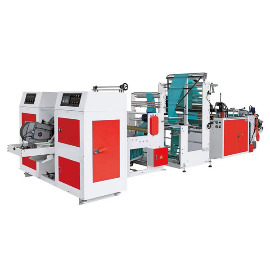
Plastic Bag Making Machine
Problem 3: Film wrinkling – folds or ripples in the bag that cause uneven seals and poor appearance. Causes: improper tension (too high or too low), misaligned guide rollers, uneven unwind roll, or film with excessive curl. Fix: adjust the dancer arm tension – increase if film is loose, decrease if stretched. Align all guide rollers using a straight edge; check the edge guide sensor for correct positioning. If the film roll has a hard edge, rewind it or use a different roll. Problem 4: Inaccurate cutting – bags that are too long or too short, or have ragged edges. Causes: encoder drift, belt slippage, dull blade, or incorrect cut length setting. Fix: measure actual bag length with a ruler and compare with the set value; adjust the cut length parameter. Check the encoder coupling for tightness. Sharpen or replace the cutting blade. For guillotine cutters, adjust blade clearance to 0.02-0.05 mm.
Problem 5: Registration misalignment – printed graphics not centered on the bag or cut off. Causes: dirty registration sensor, incorrect sensor gain, film slippage, or poor print mark contrast. Fix: clean the sensor lens with a soft cloth; recalibrate the sensor using a test mark. Increase the nip roller pressure to prevent slippage. If using a camera system, check the lighting and adjust the exposure. For films with faint marks, consider using a different mark color or adding a black background stripe. Problem 6: Bag sticking together in the stacker – causes static electricity, residual heat, or excessive pressure. Fix: install an electrostatic eliminator (ionizing bar) near the stacker. Increase cooling time by adding a chill roller before stacking. Reduce compression pressure on the stacker. For perforated rolls, bags may stick due to heat – ensure the film is fully cooled before winding.
Problem 7: Jams in the punch or die-cutting unit – common in T-shirt and vest bag machines. Causes: dull punch dies, misalignment, or film debris. Fix: clean the punch dies and check for wear; sharpen or replace. Realign the punch unit with the film path using alignment marks. Ensure the film is not too thick for the punch capacity. Problem 8: Zipper misalignment or poor zipper adhesion – for zipper bag machines. Causes: incorrect zipper guide setting, temperature too low, or pressure uneven. Fix: adjust the zipper guide to center the zipper on the film. Increase the zipper sealing temperature by 5°C. Check the pressure on the zipper sealing rollers; ensure they are parallel. Problem 9: Inconsistent bag length – may be caused by film slippage on the feed rollers, encoder failure, or incorrect setting. Fix: clean the feed rollers with a solvent to improve grip; increase nip pressure. Check the encoder coupling and replace if worn. Measure film feed per cycle and adjust the machine's length factor. Problem 10: Electrical faults – PLC alarms, heater failure, or sensor no-output. Fix: consult the machine's error code list; for heater failure, check the SSR and thermocouple. For sensor issues, test with a multimeter and replace if faulty. Ensure power supply voltage is stable.
To prevent these problems, implement a proactive monitoring system: record seal temperature, pressure, and bag dimensions every hour. Train operators to recognize early symptoms – e.g., slight increase in reject rate often precedes a major issue. Keep a troubleshooting log that documents each problem, its root cause, and the corrective action taken for each film type and bag style. This knowledge base accelerates future diagnostics. Additionally, schedule regular calibration of sensors and controllers using certified reference tools. By mastering these common problem solutions, plant personnel can resolve most issues within minutes, maintaining high productivity and minimizing scrap, thus ensuring customer satisfaction and profitability.