bag making machine cost
Understanding the full cost of a bag making machine goes far beyond the initial purchase price. The total cost of ownership (TCO) includes capital expenditure, installation, operator training, energy consumption, labor, maintenance, spare parts, and consumables over the machine's lifespan. For a typical mid-range automatic T-shirt bag machine, the purchase price might be $60,000, but the TCO over 5 years can exceed $180,000. This guide provides a comprehensive breakdown of all cost components, helping buyers create accurate budgets and evaluate the return on investment (ROI). It covers both direct costs (electricity, film waste, repairs) and indirect costs (downtime, quality rejects, training). By understanding these factors, manufacturers can make data-driven decisions and optimize their bag production economics.
Capital investment: This is the upfront payment for the machine, including any optional modules. For a new servo-driven T-shirt bag machine (200 BPM, single lane, 4-color printer), the typical price is $60,000-$100,000. Import duties (if applicable) range from 5-20% of the machine value. Shipping and freight can be $2,000-$10,000 depending on origin and destination. Installation costs include foundation preparation (if heavy), electrical wiring, and compressed air piping – typically $3,000-$15,000. Commissioning by the supplier's technician, including trial runs, is often included but may be extra ($2,000-$5,000). Financing costs: if financed at 6% interest over 5 years, interest adds roughly $10,000-$20,000 to the total paid.
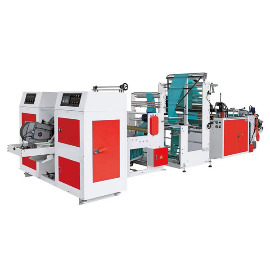
Plastic Bag Making Machine
Operating costs – energy: Bag making machines consume electricity for heating sealing bars, driving motors, and running the control system. A typical 25 kW machine running 16 hours/day, 5 days/week, at $0.12/kWh costs about $24,000/year. Servo machines are 30-40% more efficient than clutch-brake, saving $7,000-$10,000 annually. Compressed air costs: pneumatic machines consume air – a compressor of 10 HP, operating 16 hours/day, costs about $3,000/year in electricity. Labor: one operator can run 1-2 machines; annual wage is typically $30,000-$50,000 per operator. If you reduce labor from 2 operators to 1 with automation, the savings are significant. Film waste: typical waste is 2-5% of film input. For a plant consuming 500 tons/year of film at $1,200/ton, waste costs $12,000-$30,000/year. Reduced waste from better registration and tension control can save thousands.
Maintenance and consumables: Annual maintenance contract (if outsourced) costs $3,000-$15,000. Spare parts – sealing bar coverings, heaters, thermocouples, blades, O-rings – average $2,000-$5,000/year for a single machine. Lubricants and cleaning agents add $500-$1,000/year. Major repairs (servo motor replacement, gearbox overhaul) occur every 3-5 years and can cost $5,000-$15,000 each. Budgeting 3-5% of machine cost per year for maintenance is a common rule of thumb. Downside costs: unplanned downtime can cost $200-$500 per hour in lost production and labor. Therefore, investing in preventive maintenance is cost-effective.
Return on investment calculation: To determine ROI, calculate annual revenue from bag sales. For example, a machine producing 200 bags/min at 16 hours/day, 5 days/week, 50 weeks/year produces 96 million bags/year. At a selling price of $0.02/bag (typical for T-shirt bags), annual revenue is $1.92 million. Subtract film cost (assuming 5% waste, film cost $0.012/bag) = $1.152 million. Subtract energy $24,000, labor $40,000, maintenance $10,000, consumables $3,000, rent/overhead $20,000 = total operating costs ~$1.249 million. Gross profit = $1.92 - $1.249 = $0.671 million. Payback period = machine investment / annual profit = $80,000 / $671,000 = just over 1 month. However, this is a simplified example; actual margins vary. The key is to use your own numbers to validate the investment.
Cost reduction strategies: Choose energy-efficient servo drives to lower electricity bills. Implement automatic splicing to reduce film waste from roll changes. Use high-quality consumables that last longer (e.g., tungsten carbide punches instead of steel). Optimize changeover time to reduce downtime – quick-change tooling pays back quickly. Train operators on proper settings to minimize reject rates. Consider leasing instead of buying to preserve cash flow. Also, compare total cost per bag across different machine options – a more expensive machine may have lower per-bag cost due to higher speed and lower waste. By conducting a thorough cost analysis, manufacturers can select the machine that offers the best balance of investment and operating expenses, ensuring profitability and competitiveness in the bag market.