bag making machine custom
A custom bag making machine is engineered to meet specific production requirements that standard off-the-shelf machines cannot fulfill. Customization can range from minor adjustments – such as a special seal pattern or a unique punch shape – to major redesigns like handling unusual film materials, integrating with existing production lines, or achieving non-standard speeds. Custom machines are essential for producers of niche bags: medical sterile pouches, heavy-duty multi-wall sacks, biodegradable films with unique melting properties, or bags with intricate closure systems. This guide covers the custom machine development process, how to specify your requirements effectively, cost and lead time implications, and best practices for collaborating with manufacturers to achieve a successful custom solution.
When to consider a custom machine: If your product requires a bag size, shape, or feature that is not available in standard catalogs, custom is necessary. For example, producing bags with asymmetrical handles, bags with reinforced patches, or bags that require multiple sealing zones with different temperatures. Also, if you need to integrate the bag machine with upstream (extrusion) or downstream (filling, labeling) equipment, a custom interface may be required. If you use proprietary films that have unusual slip properties or heat sensitivity, the machine may need modified tension control, cooling, or sealing parameters. Finally, if you have strict quality standards that exceed industry norms (e.g., medical-grade seal integrity), a custom machine with advanced sensors and controls is justified.
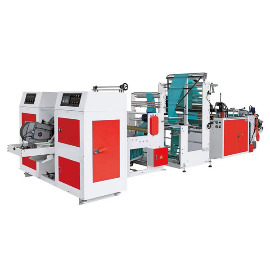
Plastic Bag Making Machine
Steps in custom development: The process starts with a detailed requirements specification. Provide the manufacturer with complete information: bag dimensions (including tolerances), material type and thickness, output speed, seal strength requirements, any special features (handles, zippers, perforations), and environmental conditions (cleanroom, high humidity). Also, specify the desired control interface, connectivity (e.g., OPC UA for Industry 4.0), and safety standards. The manufacturer then performs a feasibility study, which may involve simulation or small-scale prototyping. If feasible, they develop a detailed engineering design, including mechanical drawings, electrical schematics, and software flowcharts. After customer approval, they build a prototype machine or a first unit. Prototype testing is critical – run extensive trials with your actual film to verify all parameters. Iterative adjustments may be needed. Once validated, the manufacturer produces the final machine(s).
Cost and lead time: Custom machines are significantly more expensive than standard – often 30-100% higher due to engineering costs, custom parts, and longer assembly time. Lead times are also longer – typically 4-8 months, depending on complexity. The manufacturer will require a non-recurring engineering (NRE) fee, which covers design and development, in addition to the machine price. However, if you plan to produce a unique product that commands a premium price, the investment can be justified. Always request a detailed breakdown of NRE and per-unit costs. For high-volume custom production, consider negotiating that the NRE fee be amortized over multiple machines.
Specifying custom requirements effectively: Be as precise as possible. Provide sample bags or CAD drawings. Specify measurable criteria: seal peel strength (N/25mm), bag length tolerance (±mm), production speed at a given film thickness. Describe the film's physical properties – melt index, tensile modulus, coefficient of friction. For electrical interfaces, define the communication protocol (Modbus, Profinet, Ethernet/IP). Also, specify the operator environment – language, screen size, and any regulatory compliance (FDA, GMP). The more detailed your specification, the less chance of misunderstandings. Also, establish clear acceptance criteria for the final machine – these will be used in the acceptance test. Involve your production and maintenance teams in the specification process to ensure all operational needs are covered.
Collaborating with the manufacturer: Choose a manufacturer with proven custom engineering experience – request case studies of similar projects. Maintain regular communication during the development phase – weekly progress calls and milestone reviews. Visit the factory during critical stages: design review, assembly, and testing. For international collaboration, consider hiring a local technical consultant to represent your interests. Ensure the contract includes a clear change order process – any mid-project changes will affect cost and timeline. After delivery, ensure you receive all documentation: updated drawings, software source code (if applicable), and a detailed maintenance manual. Train your team thoroughly on the custom features. A successful custom machine project can give your company a competitive edge by enabling unique packaging solutions that are not available to your competitors.