bag making machine cutting
The cutting operation in a bag making machine separates the continuous sealed film tube into individual bags of exact length. Cutting accuracy directly affects bag dimensions, appearance, and downstream processes (like filling). There are two primary cutting mechanisms: guillotine (reciprocating) and rotary (continuous). Each has advantages based on speed, film thickness, and bag style. This guide covers the working principles of both types, how to set and adjust the cutting system, blade materials and sharpening, and common cutting defects and solutions. Proper cutting ensures clean edges, consistent bag length, and minimized waste.
Guillotine cutter: This uses a straight blade that moves vertically (or at an angle) to cut the film against a fixed anvil. The blade is typically driven by a pneumatic cylinder or a servo motor with a crank mechanism. Guillotine cutters are suitable for thicker films (over 100 microns) and for intermittent cutting at speeds up to 150 cycles/min. They provide a straight cut with minimal dust. The blade must be kept sharp and adjusted to have the correct clearance (0.02-0.05 mm) from the anvil. Too much clearance causes ragged edges; too little causes blade wear and noise. Guillotine cutters require lubrication on the slide ways. They are common in heavy-duty sack machines and zipper bag machines.
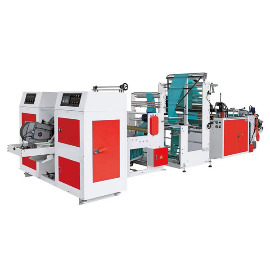
Plastic Bag Making Machine
Rotary cutter: This uses a cylindrical blade (or multiple blades) that rotates against a fixed counter-blade or anvil roller. The film passes between them, and the rotating action slices continuously. Rotary cutters are faster, allowing speeds over 200 cycles/min, and produce a smooth cut. They are preferred for high-speed flat, T-shirt, and vest bag machines. The blade is often made of high-speed steel or tungsten carbide and can be sharpened on the machine using a grinder attachment. The clearance between the rotary blade and anvil is critical – typically 0.01-0.03 mm. Over time, the anvil may wear, causing uneven cutting; replace or regrind it. Rotary cutters produce less vibration and are quieter than guillotine types.
Hot wire cutting: For synthetic woven fabrics (e.g., PP woven), a heated wire or blade may be used to cut and seal the edge simultaneously, preventing fraying. This is less common in standard film bag machines but used in some industrial sack lines.
Adjusting cut length: The cut length is determined by the feeding speed and the timing of the cut. In servo-driven machines, the pull roller servo rotates a precise amount to feed the film, and the cut is triggered by an encoder signal. For machines with a mechanical clutch, the feed roll is driven by a cam. If the cut length is inconsistent, check the encoder coupling, belt tension, and the registration system. Also, ensure the film is not slipping on the feed rollers. Use a ruler to verify the actual bag length and adjust the machine's cut length parameter accordingly.
Blade maintenance: Dull blades are the primary cause of ragged cuts, dust, and increased machine load. The blade should be inspected daily – if it shows nicks or loss of sharpness, it should be replaced or sharpened. For rotary cutters, use a dedicated grinding tool; for guillotine, remove the blade and sharpen on a surface grinder. Always handle blades with care – they are extremely sharp. Keep spare blades in stock. The anvil or counter-blade should also be inspected for wear – if grooved, replace or regrind. Proper blade maintenance extends cutting life and reduces motor load, saving energy and improving cut quality.
Troubleshooting cutting defects: 1) Ragged edges – dull blade or incorrect clearance. 2) Incomplete cut – blade not fully engaging, or film thickness exceeding capacity. 3) Uneven length – registration or feed roller issue. 4) Dust or debris – blade wear or incorrect cutting angle. 5) Burrs – blade nicks. For high-speed machines, consider using a dust extraction system to keep the cutting area clean. By maintaining the cutting system in optimal condition, operators can achieve clean, accurate cuts that contribute to overall bag quality and customer satisfaction.