bag making machine film feeding
Film feeding is the foundational operation of any bag making machine – it involves unwinding the film roll, maintaining consistent tension, guiding the film straight through the machine, and feeding it accurately to the sealing and cutting stations. Proper film feeding ensures that the film does not wrinkle, stretch, or misalign, which would cause seal defects, registration errors, and bag size variations. The feeding system comprises the unwind stand, tension sensors, dancer rollers, nip rollers, edge guide sensors, and pull rollers. This guide explains each component, how they work together, and how to set up and troubleshoot film feeding for different film materials and thicknesses.
Unwind stand and roll mounting: The film roll is mounted on a shaft that fits into the unwind stand. The shaft may be mechanical (with expanding mandrels) or air-shaft (with inflatable bladders) for easy loading. The roll must be centered on the shaft to prevent uneven tension. The brake system (mechanical or electromagnetic) applies resistance to the roll to control unwinding speed and prevent the roll from freewheeling. For automatic machines, a dancer arm or load cell measures the film tension and adjusts the brake or the unwinding motor (in servo-driven systems) to maintain constant tension. For sensitive films (biodegradable or thin gauge), a low-inertia brake is essential to avoid snapping.
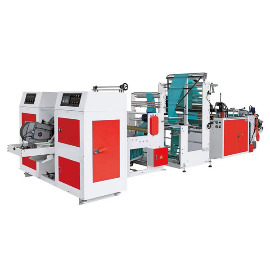
Plastic Bag Making Machine
Tension control: Constant tension is critical to prevent film deformation. Tension too high stretches the film, changing its thickness and width, and can cause necking. Tension too low allows the film to sag or wander off the guide rollers. The setpoint depends on film type and thickness – typically 10-30 N for 50-micron LDPE, up to 100 N for thicker films. The dancer arm provides a mechanical buffer: it moves up and down to absorb speed variations, and its position is used as a feedback signal to the controller. Load cells provide direct force measurement and are more precise. For high-speed machines, a combination of dancer and load cell is used. Operators should adjust the tension setpoint based on the film's behavior and check for any flutter or slipping.
Web guiding (edge guiding): Film must travel straight through the machine to ensure accurate sealing and cutting. An edge guide sensor (ultrasonic or optical) detects the film edge position and sends a signal to a steering roller or a lateral shift mechanism that moves the unwind stand or a guide roller to correct the path. This ensures the film stays centered. Misalignment causes seals to be off-center, bag width variation, and edge trimming waste. Calibrate the edge guide when changing film rolls, and clean the sensor lens regularly. For films with poor edge quality, a line guide (detecting a printed line) may be used instead of edge detection.
Nip rollers and pull rollers: After the tension control section, the film passes through a set of driven nip rollers that pull the film through the machine. These rollers are synchronized with the sealing and cutting cycle to feed the exact length of film for each bag. For servo-driven machines, the pull roller servo is programmed to accelerate and decelerate smoothly to match the bag length. The nip pressure must be sufficient to grip the film without slipping, but not so high as to leave marks or compress the film. For slippery films (e.g., with slip agents), use rollers with a rubber coating or higher pressure.
Troubleshooting film feeding issues: Wrinkling – often caused by uneven tension or misaligned rollers; check roller parallelism and tension balance. Slipping – insufficient nip pressure or worn rubber rollers; clean or replace rollers. Film wandering – edge guide sensor dirty or mis-calibrated; clean and recalibrate. Film breaks – tension too high or a bad splice; reduce tension and check splice quality. Film sticking – static electricity; use an anti-static bar. By carefully setting up and monitoring the film feeding system, operators can ensure smooth, consistent film transport, which is the prerequisite for high-quality bag production and minimal waste.