bag making machine for shopping bags
A bag making machine for shopping bags is a specialized production system designed to manufacture the high-volume, lightweight plastic bags used by supermarkets, department stores, boutiques, and convenience stores for customer purchases. These machines predominantly produce T-shirt bags (with cut-out handles), vest bags (with die-cut handles and often gussets), and flat bags without handles. Shopping bag machines are optimized for speed, typically running at 120 to 250 bags per minute, and are often integrated with in-line flexographic printing to apply store logos, barcodes, and promotional messages. The film used is usually LDPE or HDPE with thicknesses from 15 to 60 microns, balancing strength with material economy. With the global push for sustainability, many shopping bag machines are now adapted to process biodegradable films and recycled content, while maintaining the high output required by large retail chains. These machines are the backbone of the retail packaging supply chain, producing billions of shopping bags annually.
The operational workflow of a bag making machine for shopping bags varies by bag style. For T-shirt bags, the film unwinds from a roll, passes through tension control and guide rollers, then enters the sealing station where a bottom seal is applied. The film then moves to the handle punching station, where a die or rotary punch cuts out the handle holes and a central notch for easy dispensing. After punching, the film is cut to length by a rotary or guillotine knife, and the finished bags are stacked on a conveyor. For vest bags, an additional gusset former may be integrated before the sealing station, and the handle cutting is done by a die-cutting cylinder that produces reinforced handle shapes. In both cases, a registration camera ensures that prints align with the handle cut-outs. The stacking unit counts bags into bundles (typically 50-100 pieces) and compresses them for packing. Many machines include an automatic splicer for continuous roll changes, reducing downtime.
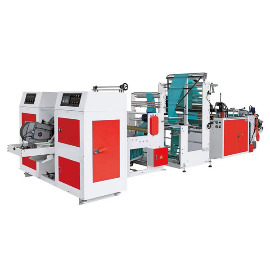
Plastic Bag Making Machine
Key technical specifications for shopping bag machines include bag width (200-700 mm for T-shirt/vest, up to 1200 mm for flat), bag length (300-800 mm), film thickness (15-60 microns), production speed (120-250 BPM for T-shirt, 80-150 BPM for vest, up to 300 BPM for flat). The punching or die-cutting unit must be capable of high-frequency operation, with punch forces of 2-10 tons depending on handle design. The printing station typically supports 2-6 colors with registration accuracy of ±0.3 mm. Sealing temperature ranges from 120-180°C, with separate zones for bottom seal and handle reinforcement (if used). Power consumption is 15-40 kW, and compressed air requirement is 6-8 bar at 600-1000 L/min. The stacking unit often includes a compression plate to flatten bags for neat stacking. Optional features include an automatic roll loader, a hole punch for hanging displays, and an in-line bag opener for retail dispensing.
Shopping bag machines are the primary source of carry-out bags for supermarkets, hypermarkets, and grocery stores. They are also used by clothing retailers, pharmacies, convenience stores, and fast-food chains. Promotional events and trade shows use custom-printed shopping bags as advertising giveaways. With the rise of e-commerce, some shopping bag machines are reconfigured to produce poly mailer bags for shipping, though these typically lack handles. In regions with plastic bag bans, shopping bag machines are being retooled to produce heavier reusable PE bags or to process compostable films like PLA and PBAT, which require lower sealing temperatures and modified punch settings to prevent material tear. The versatility of these machines allows converters to serve both traditional retail and emerging sustainable markets.
Selecting a bag making machine for shopping bags requires evaluating the primary bag style (T-shirt vs. vest), print requirements, and output volume. For a supermarket chain that uses hundreds of thousands of bags per day, a high-speed servo-driven T-shirt bag machine with 4-color printing and automatic stacking is ideal. For a boutique that needs a premium look, a vest bag machine with die-cut handles and optional gusset former is recommended. Consider the handle strength – T-shirt handles are simpler but less robust; vest handles are stronger but require more film and a more expensive die-cutting unit. If you produce printed bags, ensure the registration system can handle high speeds (200+ BPM) and that the printing unit's drying system is adequate to prevent smearing. Changeover time is crucial for converters handling multiple store brands; look for machines with quick-release punch dies and adjustable sealing bars. Finally, check the machine's compatibility with recycled and biodegradable films, as many retailers are transitioning to these materials. Request trial runs with your specific film to verify seal strength and punch quality.
Maintenance of a shopping bag machine focuses on the punching/die-cutting and printing sections. The punch dies require daily cleaning to remove film residue and regular sharpening (every 1-2 million cycles) to ensure clean handle cuts. For vest bag die-cutters, inspect the die knives weekly for wear, as dull knives produce jagged handles that can tear during use. The printing anilox rollers must be cleaned after each shift to prevent ink buildup; doctor blades should be replaced weekly. Sealing bars need daily cleaning with a brass brush to remove carbon deposits. Registration cameras should be calibrated weekly and lenses cleaned daily. Lubricate all high-speed bearings and cam followers monthly. Since shopping bag machines often run continuous shifts, implement a predictive maintenance program that monitors vibration and motor currents to detect early wear. Keep a stock of consumables – punch dies, anilox rollers, sealing bar coverings – to minimize downtime. By maintaining these key sections, the machine can deliver consistent bag quality, sharp prints, and reliable output, ensuring retailers receive their branded shopping bags on time and within quality standards.