bag making machine heat sealing
Heat sealing is the most critical operation in a bag making machine, as it determines the bag's integrity, strength, and barrier properties. The process uses heat and pressure to fuse thermoplastic film layers at the seal area, creating a molecular bond. Proper heat sealing requires precise control of three interdependent parameters: temperature, pressure, and dwell time. This guide explains the physics of heat sealing, how to optimize the sealing parameters for different film materials (PE, PP, PET, PLA, etc.), and how to diagnose and correct common sealing defects. It also covers sealing bar design, temperature profiling, and the importance of cooling in high-speed production.
Sealing mechanisms: The seal is formed by applying heat to soften the film surface, then pressure to bring the melted layers together, followed by cooling to solidify the bond. The process must be fast enough for production speed but long enough to achieve adequate melt flow and intermolecular diffusion. The heat can be applied via impulse sealing (a wire that heats and cools rapidly) or constant heat sealing (a heated bar maintained at a set temperature). Impulse sealing is energy-efficient and suitable for thin films but has a lower maximum speed. Constant heat is common in high-speed machines because it allows continuous operation, but requires careful temperature management to prevent overheating at low speeds.
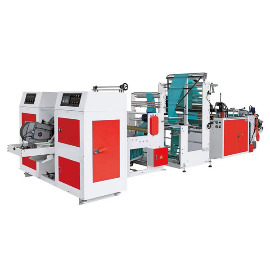
Plastic Bag Making Machine
Key parameters: Temperature – the most critical setting. Too low results in weak seals (cold seal); too high causes burn-through, whitening, or degradation. The optimal temperature depends on the film's melting point, thickness, and thermal conductivity. For LDPE, 120-160°C; for HDPE, 160-200°C; for PP, 170-220°C; for biodegradable PLA, 100-140°C. Pressure – ensures intimate contact between film layers. Insufficient pressure leads to incomplete seals; excessive pressure can squeeze out melted material, thinning the seal. Typically 3-6 bar pneumatic, up to 50 tons for hydraulic machines. Dwell time – the duration the sealing bars are clamped. For high speeds, dwell time is short (0.1-0.5s), so temperature must be higher to compensate. For thick films, longer dwell is needed. The relationship: higher speed = shorter dwell = higher temperature needed, but there is a limit – too high temperature causes degradation. Manufacturers provide speed-temperature curves.
Sealing bar design: Bars are usually made of aluminum or copper with a Teflon or silicone covering to prevent sticking. The covering must be replaced regularly. The bar surface should be flat and smooth to provide uniform pressure. Some machines have segmented bars to compensate for film thickness variations. Temperature uniformity across the bar is crucial – use multiple thermocouples and heaters. A temperature variation of ±2°C can affect seal strength. Modern machines use PID controllers with auto-tuning to maintain stability.
Cooling: After sealing, the film must be cooled to set the seal. Cooling is often achieved by passing the sealed area over a chill roller or using forced air. Insufficient cooling can cause the seal to weaken or the film to stick to the sealing bar. The cooling rate affects crystal formation in the seal, which influences seal toughness. For fast production, water-cooled rollers are effective.
Quality control and troubleshooting: Test seal strength regularly using a peel tester – the seal should tear the film, not separate at the seal. Check seal appearance – it should be clear and uniform, without bubbles, burns, or wrinkles. Common defects: 1) Weak seal – increase temperature or pressure. 2) Burn-through – lower temperature or pressure. 3) Inconsistent seal – check temperature uniformity and bar parallelism. 4) Seal sticking to bar – clean bar and check covering. 5) Seal wrinkling – check film tension and guide alignment. By understanding and adjusting these parameters, operators can achieve optimal seal quality, ensuring bags meet the required strength and appearance standards for their intended application.