bag making machine production process
The production process of a bag making machine is a continuous, highly automated sequence of operations that converts a roll of flat plastic film into finished bags of various styles. Understanding this process is essential for operators, maintenance staff, and production managers to optimize settings, diagnose issues, and improve efficiency. The core steps are: unwinding and tension control, printing (if equipped), registration sensing, sealing (bottom, side, or both), cutting, and stacking. For specialized bags, additional steps like gusset forming, handle punching, die-cutting, or zipper application are integrated. This guide provides a step-by-step walkthrough of the production process, highlighting key parameters, quality checkpoints, and common variations for different bag types.
Step 1: Unwinding and tension control. The film roll is mounted on an unwind shaft with a braking system (mechanical or servo-controlled). The film passes through a dancer arm or load cell tension sensor that maintains constant tension, preventing stretching or wrinkling. Proper tension is critical – too low causes film wandering, too high causes elongation and thickness reduction. Step 2: Printing (optional). If the machine has an in-line flexographic or gravure printer, the film passes through print stations where ink is applied. After printing, the film passes through a drying tunnel (hot air or IR) to cure the ink before further processing. Registration marks are printed alongside the main design for later alignment.
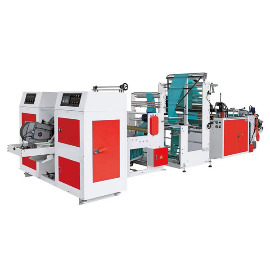
Plastic Bag Making Machine
Step 3: Registration sensing. A photoelectric sensor or CCD camera detects the registration marks on the film. The signal is used to adjust the film feed precisely so that the seal and cut positions align with the print, ensuring the bag graphics are centered. This is a closed-loop system that compensates for film slippage or elongation. Step 4: Sealing. The film enters the sealing station where heated bars (or rollers) apply heat and pressure to fuse the film layers. For bottom-seal machines, a single bar seals the bottom. For side-seal, vertical bars seal the sides. For three-side or stand-up pouches, multiple seals are applied. Sealing parameters – temperature, pressure, dwell time – are set based on film type and thickness. After sealing, the film may pass over a chill roller to cool and set the seal.
Step 5: Cutting. The sealed film is cut to individual bag length by a cutting mechanism. Common types: rotary knife (continuous, high speed), guillotine (intermittent, for thick films), or hot wire (for synthetic fabrics). The cut must be clean and perpendicular to the film edges. Step 6: Optional forming/punching. For T-shirt bags, a punch unit cuts handle holes and a center notch. For vest bags, a die-cutting station cuts reinforced handles and may form gussets. For zipper bags, a zipper applicator attaches the zipper track. For garbage bags on rolls, a perforation unit creates tear lines, and a winding station rolls the bags instead of stacking. Step 7: Stacking or winding. For flat or handled bags, a stacking conveyor collects bags, counts them, and compresses them into bundles of preset quantities. For perforated roll bags, a coreless winder rolls the continuous chain of bags into rolls. The stacking/winding unit includes a counter and an automatic discharge mechanism.
Quality control checkpoints: Throughout the process, operators monitor seal strength (peel test), bag length (measure with ruler), registration accuracy (visual inspection), and seal appearance (no whitening or burn). Many machines have in-line inspection systems – cameras or sensors that automatically reject defective bags. At the end of the line, sample bags are taken for lab testing (seal strength, tensile, and dimension). The production process is recorded in a log, including settings, speed, and waste percentage. By understanding each step and its critical parameters, operators can make precise adjustments to maintain consistent bag quality, reduce scrap, and maximize production throughput.