bag making machine repair
While routine maintenance prevents many issues, bag making machines occasionally require major repairs due to component wear, electrical failures, or physical damage. Repair goes beyond simple adjustments – it involves replacing or refurbishing critical parts such as sealing bars, heating elements, servo motors, gearboxes, PLCs, and pneumatic cylinders. Understanding when to repair in-house versus when to call a specialist is crucial to minimize downtime and cost. This guide covers the most common repair scenarios, step-by-step procedures for major component replacement, safety protocols, and best practices for sourcing replacement parts and service technicians. Proper repair restores the machine to near-original performance, extending its productive life by years.
Common repair scenarios include heater and thermocouple failure – these are the most frequent electrical repairs. Symptoms include inability to reach set temperature, temperature fluctuation, or no heat at all. Repair involves disconnecting power, removing the faulty heater cartridge or band heater, and installing a new one with the correct wattage and voltage. Always apply thermal compound to improve heat transfer. Thermocouple replacement requires careful matching of type (K, J, etc.) and correct wiring polarity. After replacement, calibrate the temperature controller using an external reference. Another frequent repair is sealing bar resurfacing – over time, the bar surface becomes pitted or uneven, causing seal defects. The bar can be removed and surface-ground to a flat finish, or replaced with a new one. If the bar is warped, it must be replaced.
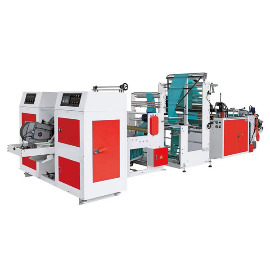
Plastic Bag Making Machine
Servo motor and drive repair is more complex. If a servo motor fails to rotate or makes excessive noise, first check the encoder and cabling. If those are intact, the motor may need replacement. Disconnect power, lock out the circuit, remove the motor coupling, and unbolt the motor. Install the new motor, align it carefully with the driven shaft, and tighten couplings. Then, run the auto-tuning procedure in the drive to recalibrate. For drive (amplifier) failure, replace the drive unit with the same model, transfer the parameter settings from the old drive (if accessible) or re-enter them from a backup. After replacement, test the axis movement at low speed and gradually increase to full speed while monitoring for vibration.
Pneumatic and hydraulic repairs involve cylinder seal replacement, valve servicing, and tubing repairs. For pneumatic cylinders that leak or fail to extend/retract, replace the piston seals and rod seals. Disassemble the cylinder, clean the barrel, and install new seals from a repair kit. For hydraulic machines, hose leaks are common – replace hoses with the same pressure rating and ensure proper routing to avoid chafing. Hydraulic pump repair requires specialized tools; often it is more cost-effective to replace the pump cartridge or the entire pump unit. Gearbox repair involves bearing and gear replacement; this is a major job requiring disassembly of the drive train. If gears are worn or chipped, replace them as a set. Reassembly requires precise backlash adjustment; use feeler gauges or dial indicators.
PLC and electrical control repairs: if the PLC fails to boot or has I/O faults, first check the power supply and battery. Replacing a PLC requires reprogramming; ensure you have a backup of the program and parameters. Many modern machines allow uploading the program from the HMI. For electrical wiring issues like broken wires or loose terminals, use a multimeter to trace continuity and repair with appropriate connectors. Always use wire of the same gauge and insulation rating.
When to call a specialist: for major overhauls involving main drive replacement, full gearbox rebuild, or complex hydraulic system repairs, it is advisable to contact the machine manufacturer or a certified service provider. They have the diagnostic tools, specialized fixtures, and technical documentation to perform the repair correctly. Also, for servo motor re-winding or encoder replacement, specialists are preferred because improper alignment can cause catastrophic failure. Establish a service agreement that includes emergency response time and a stocked van of common parts. In-house repair teams should be trained on safety lockout/tagout procedures, use of proper lifting equipment, and handling of heavy components. After any major repair, perform a full functional test: run the machine at 50% speed for 15 minutes, then 75% for 30 minutes, and finally full speed with production material, checking bag quality at each stage. Document the repair with date, parts used, labor hours, and test results. By combining skilled in-house capabilities with expert external support, bag making machine owners can ensure that repairs are done efficiently, safely, and effectively, minimizing downtime and restoring full production capacity.