bag making machine troubleshooting
Bag making machine troubleshooting is an essential skill for operators and maintenance technicians to quickly identify and resolve production issues that cause downtime, waste, and poor bag quality. Despite the advanced automation of modern bag machines, problems still arise from film variations, mechanical wear, electrical faults, or operator errors. Common issues include weak or incomplete seals, film wrinkling, inaccurate cutting, registration misalignment, jams in the stacking or winding section, and inconsistent bag length. Effective troubleshooting follows a systematic approach: observe the symptom, isolate the affected section, check settings and components, and test corrective actions. This guide covers the most frequent problems across all bag machine types – bottom-seal, side-seal, T-shirt, vest, zipper, and stand-up pouch machines – with practical diagnostic steps and solutions to minimize downtime and maintain production quality.
One of the most common issues is seal failure – either weak seals that burst under pressure, or burn-through that creates holes. Weak seals often result from insufficient temperature, too short dwell time, or low sealing pressure. Check the temperature controller against a reference thermometer; recalibrate if needed. Increase dwell time by reducing speed or adjusting the sealing bar timing. For burn-through, lower temperature or pressure, and check the film thickness – if the film is thinner than usual, reduce settings accordingly. Another frequent problem is film wrinkling, which causes uneven seals and mis-cuts. Wrinkling usually stems from improper tension, misaligned guide rollers, or uneven film roll. Check the dancer arm tension setting; increase tension if film is loose, or decrease if film is stretched. Inspect the guide rollers for wear or misalignment; adjust the edge guide system to center the film. Wrinkling can also occur if the film has excessive curl – try using a pre-heating roller.
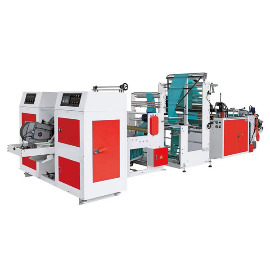
Plastic Bag Making Machine
Cutting problems – such as ragged edges, incomplete cuts, or knife jams – are often due to dull blades, incorrect knife clearance, or improper timing. For guillotine cutters, check blade sharpness and replace or sharpen it if it produces fuzzy edges. Adjust the clearance between the fixed and moving blades to 0.02-0.05 mm for clean cuts. For rotary cutters, check the blade alignment and the anvil roll condition. If the knife jams, look for film debris stuck in the blade holder. Registration errors occur when the print mark is not aligned with the seal or cut. This is typically caused by a dirty or misaligned photo-eye sensor, incorrect registration settings, or film slippage. Clean the sensor lens with a soft cloth; recalibrate the sensor gain. Check the film drive rollers for wear that could cause slippage; increase the nip pressure if needed. Verify the registration mark color and contrast – some films have poor contrast, requiring a different sensor type (ultrasonic).
Stacking and winding issues include bags sticking together, misfolding, or uneven stacks. Sticking often results from high static charge or residual heat; install an electrostatic eliminator or increase cooling time. For perforated rolls, improper perforation strength causes either difficulty tearing or premature tearing. Adjust the perforation blade depth and pressure; test with sample film. Inconsistent bag length can be caused by encoder errors, belt slip, or incorrect cut length settings. Check the encoder coupling for tightness; measure the actual film feed with a ruler and compare with the set value. If the machine uses a dancer pot, calibrate the potentiometer. Electrical faults like heater failure, sensor failure, or PLC alarms require referencing the machine's manual and using diagnostic modes. Most modern machines display error codes; consult the code list. For heater failure, check the SSR (solid state relay) and thermocouple; replace if needed. For sensor issues, test the sensor output with a multimeter.
Preventive troubleshooting involves regular monitoring of key indicators: seal temperature, pressure, bag length, and defect rate. Implement a checklist for daily, weekly, and monthly checks. Training operators to recognize early signs of problems – e.g., slight increase in reject rate, unusual noise, or temperature fluctuation – can prevent major breakdowns. Maintain a log of all issues and solutions for each film type, as many problems are material-specific. For example, biodegradable films require lower temperatures and longer dwell, while recycled films may need higher pressure. When troubleshooting a new film, start with conservative settings and incrementally adjust. Always have a set of spare common parts: heating elements, thermocouples, blades, and sensors. By adopting systematic troubleshooting procedures, operators can resolve most issues within minutes, minimizing production loss and maintaining the quality that customers expect.