bag making machine with printing
A bag making machine with printing integrates a printing unit directly into the bag production line, allowing the conversion of plain film into printed finished bags in a single continuous process. This integration eliminates the need for a separate printing step, reducing material handling, lowering labor costs, and minimizing waste from registration errors. Bag making machines with printing are widely used for producing branded retail bags, food packaging pouches, and promotional bags where graphics, logos, barcodes, and usage instructions are essential. The printing unit can be flexographic (most common), gravure, or digital, with flexo being the most prevalent due to its cost-effectiveness for medium to long runs and its ability to print on various film substrates.
The operational workflow of a bag making machine with printing begins with the film unwinding, similar to a standard bag machine, but with an additional printing station positioned before the sealing and cutting section. In a flexographic configuration, the film passes over a series of print stations, each containing an anilox roller that transfers ink from the ink pan to a printing plate mounted on a plate cylinder. The printing plate then contacts the film, transferring the ink image. Each color requires a separate station, typically up to 6-8 colors for full-color designs. After printing, the film enters a drying tunnel (often hot air or infrared) to cure the ink before it reaches the sealing bars, preventing smearing. The printed film then goes through the same bag making process – sealing, cutting, stacking – with the added challenge of maintaining precise registration between the print and the seal/cut positions. This is achieved using a high-speed registration camera that detects print marks and adjusts the film feed in real-time, ensuring that the cut occurs exactly at the designated position.
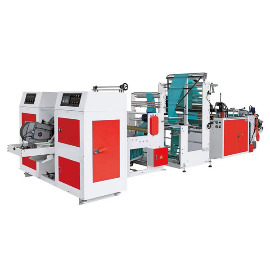
Plastic Bag Making Machine
Key technical parameters for the printing section of a bag making machine include print width, color capacity, printing speed, and registration accuracy. Print width matches the machine's maximum film width, commonly up to 1200 mm, with some machines handling 1600 mm. Color capacity typically ranges from 2 to 8 colors, with 4-6 being most common for standard retail bags. Printing speed is synchronized with the bag making speed – the entire machine runs at the same line speed, which for integrated units is usually 100-200 meters per minute, translating to 100-250 bags per minute depending on bag length. Registration accuracy is paramount; modern systems maintain ±0.3 mm, using CCD cameras with 200 Hz update rates and servo-driven dancer rollers that adjust film position within milliseconds. Ink type includes solvent-based, water-based, and UV-curable; water-based inks are preferred for food packaging due to low VOC emissions. The drying system must be powerful enough to fully cure the ink before sealing, yet not overheat the film, which can cause distortion. Many machines employ a chilled roller after the dryer to cool the film back to ambient temperature.
There are two main integration configurations for bag making machines with printing: the "in-line" type where the printer is an integral part of the machine, sharing the same control system and drive, and the "off-line" type where a separate printing unit is placed immediately upstream of the bag maker, with a web guide and dancer to synchronize speeds. The in-line type offers better registration and simpler operation, as a single PLC controls everything, but it is less flexible if the printer needs maintenance. The off-line type allows running the printer at different speeds for pre-printing, but requires careful tension management between the two units. Most modern high-volume lines prefer in-line integration for its ease and reliability. Additionally, some bag making machines with printing include a coating unit after printing to apply a protective lacquer or cold seal adhesive, expanding the machine's capability to produce specialized packaging like confectionery wrappers.
Applications of bag making machines with printing span all sectors that require branded or informative packaging. In the food industry, printed bags for snacks, frozen vegetables, coffee, and tea rely on these machines to display nutritional information, cooking instructions, and attractive graphics that drive consumer choice. Retail shopping bags are printed with store logos and promotional messages, turning each bag into a mobile advertisement. E-commerce poly mailers often include brand logos and barcode labels, enabling automated sorting and tracking. Medical packaging uses printing to display lot numbers, expiration dates, and sterilization indicators, which are critical for traceability and patient safety. Agricultural bags for seeds and fertilizers carry usage guidelines and regulatory warnings. The ability to print variable data (like serialized barcodes) is increasingly in demand, and some machines incorporate digital print heads that can change the print image on the fly, offering personalization for campaigns or small batches.
Selecting a
bag making machine with printing requires evaluating print quality needs, production volume, and ink compatibility. First, determine the required print resolution and number of colors; flexo offers 80-150 lpi (lines per inch) for solid colors, while gravure provides higher resolution for continuous tones but is more expensive and slower to change over. Choose between water-based and solvent-based inks – water-based is eco-friendly but requires longer drying, which may limit speed; solvent-based dries faster but needs solvent recovery systems. The drying energy cost is significant, so assess the machine's drying efficiency and whether it uses hot air, IR, or UV. For variable data printing, consider a digital inline unit (e.g., inkjet) that can print unique codes without expensive plate changes. Also, evaluate the registration system's response time; for high-speed lines, a camera with a high frame rate and a servo-driven register roller is essential. Ensure the printing unit is easily accessible for cleaning and plate changes, as print quality deteriorates quickly if ink buildup occurs. Finally, factor in the cost of printing consumables (ink, solvents, plates, cleaning agents) as these can represent a significant portion of operating expenses.
Maintenance of the printing section is critical to prevent print defects that can ruin thousands of bags. Daily, clean the anilox rollers with a specialized cleaning solution and brush to remove dried ink from the cells, as clogged cells cause poor ink transfer and color inconsistency. Inspect the doctor blades for wear and replace them if they show scoring. Clean the printing plates with a gentle cleaner and store them properly to avoid damage. Weekly, check the drying system's air filters and heat elements; clean or replace filters to maintain efficient drying. Calibrate the registration camera by running a test pattern and adjusting the sensor alignment. Monthly, perform a viscosity check on the inks and adjust with appropriate solvents to maintain optimal flow properties. Monitor the pressure between the plate cylinder and the impression cylinder; incorrect pressure leads to dot gain or ghosting. Keep a log of print quality tests and environmental conditions (temperature, humidity) because ink behavior changes significantly with these variables. By adhering to a rigorous maintenance schedule, a bag making machine with printing can produce consistently high-quality printed bags, enhancing brand value and reducing the need for reprints, ultimately providing a competitive edge in the packaging market.